
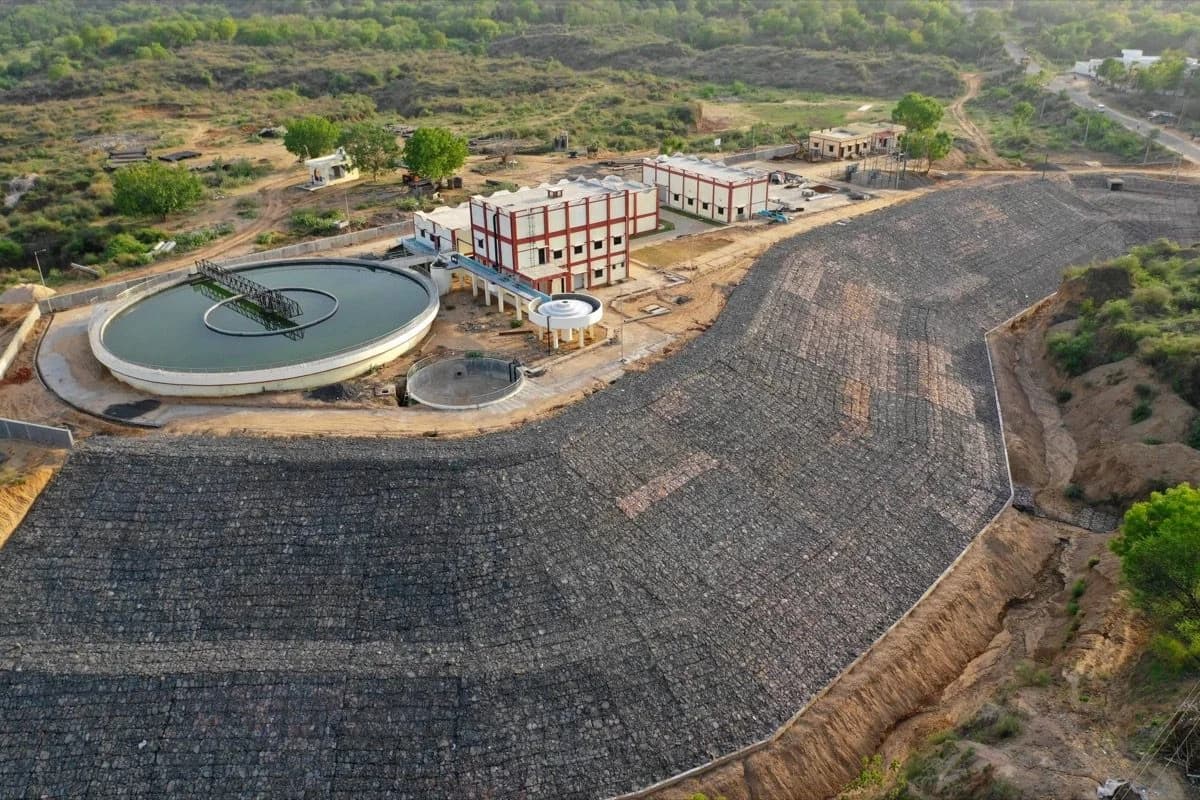
WTP Technologies and Their Civil Requirements
Conventional WTP (for surface water — rivers, reservoirs):
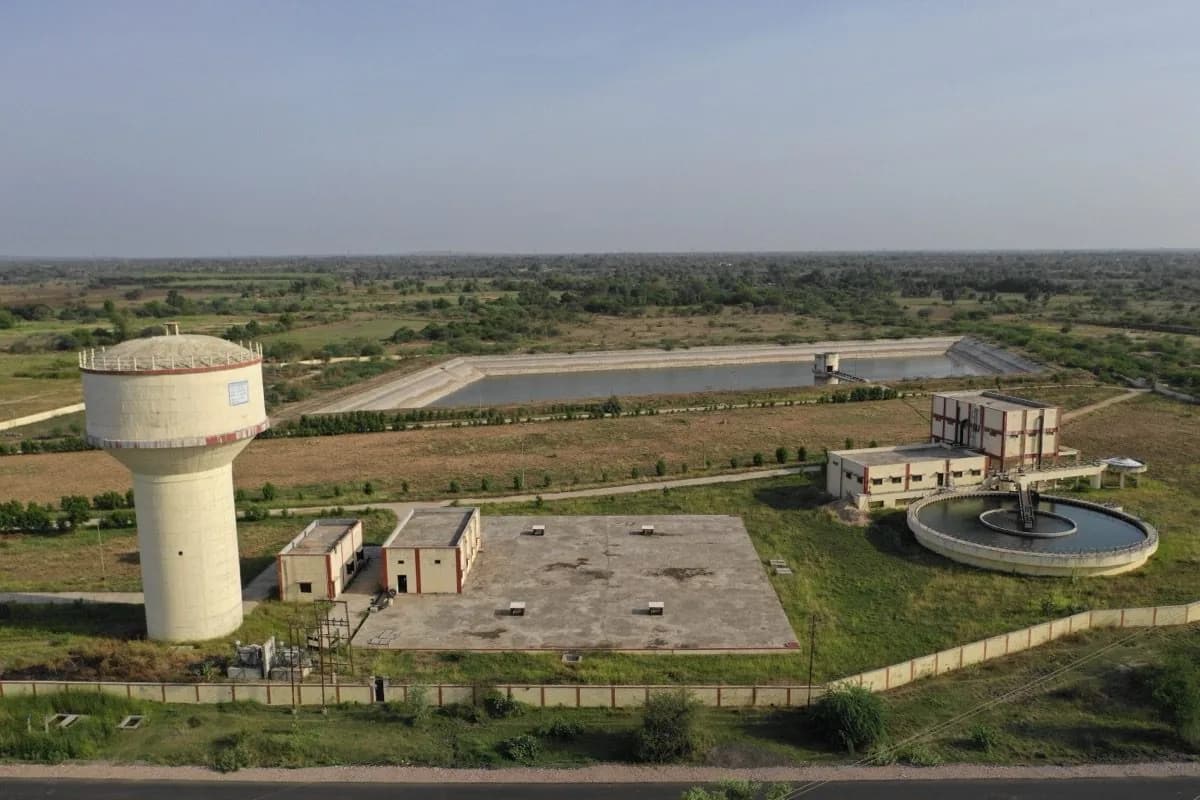
The proven treatment train: Intake → Aeration → Flash Mixer → Clariflocculator → Rapid Sand Filter → Disinfection → Clear Water Reservoir. - Civil scope: 60–70% of project cost - Best for: 10–500 MLD capacity, permanent installations - Design life: 30+ years for civil structures
Packaged/Compact WTP:
Factory-manufactured steel or FRP units combining mixing, settling, and filtration in a single vessel or skid-mounted assembly. - Civil scope: 20–30% (mainly foundation slab, pipe gallery, CWR) - Best for: 0.5–10 MLD, remote locations, fast deployment - Used extensively in Jal Jeevan Mission rural schemes
UF/NF/RO Membrane Plants:
Membrane filtration replacing or supplementing conventional treatment. Produces superior water quality. - Civil scope: 30–40% (process building, CWR, waste handling) - Best for: 1–100 MLD, treated sewage recycling, brackish groundwater
VRSIPL has constructed WTPs from 5 MLD to 200 MLD — including the complete range from conventional clariflocculator-based plants to modern membrane-ready installations.
Conventional WTP — Civil Construction Scope
A typical 50 MLD conventional WTP requires the following civil structures:
1. Intake Structure (at river/reservoir):
- Jack well or intake tower in the water body - Suction/gravity pipeline to WTP site - Approach bridge or catwalk to intake
2. Aeration Cascade:
- Stepped cascade structure (5–7 steps, 300mm each) for oxygen addition and CO₂ removal - RCC with smooth hydraulic profile
3. Flash Mixer:
- Rapid mixing chamber (detention time 30–60 seconds) - Chemical dosing platform above
4. Clariflocculator:
- Circular RCC tank (typically 20–40m dia, 3.5–4.5m SWD) - Central flocculation zone with slow-speed paddle arrangement - Peripheral clarification zone with radial launders - Sludge hopper and scraper bridge support columns - Inlet and outlet arrangements designed for uniform flow distribution
5. Rapid Sand Filter (RSF):
- Rectangular RCC filter boxes (typically 6m × 12m plan, 3.5m deep) - Under-drain system (lateral + manifold or Wheeler bottom) - Wash water trough, gullet, and pipe gallery - Filter media support (graded gravel) and filter sand - Rate control and backwash arrangements
6. Clear Water Reservoir (CWR):
- Underground or semi-underground RCC tank storing 4–8 hours of treated water - Baffled for disinfection contact time (30 minutes at peak flow) - Inlet, outlet, overflow, drain, and scour arrangements
7. Sludge Handling:
- Sludge collection sump - Sludge drying beds (10–15 beds of 10m × 15m each) - Supernatant return channel
8. Chemical Building:
- Alum/PAC storage and dissolving tanks - Chlorine/chlorine dioxide room (with safety provisions) - Lime storage and slaking plant area - Polymer preparation room
9. Pump House:
- Raw water pump house (if not gravity-fed) - Treated water pump house (high-lift) - Backwash water pump room
10. Administration & Laboratory:
- Lab for daily water quality testing - SCADA/control room - Staff quarters (for remote locations)
Critical Quality Parameters for WTP Civil Works
WTP civil construction demands hydraulic accuracy and watertightness:
Hydraulic Levels:
Water flows through a WTP by gravity — each unit is set at a precisely calculated level to maintain flow without pumping between stages. A 50mm error in one unit's level can cause overflow or inadequate flow. All levels must be surveyed and confirmed against the hydraulic gradient line (HGL) before concreting.
Watertightness:
All tanks must pass the IS 3370 water test (< 1/500 capacity per 24 hours). Construction joints with PVC water-stops, M30+ concrete with 0.45 W/C ratio, and 14+ days curing are mandatory.
Flow Distribution:
Clariflocculator inlet must distribute flow uniformly across the tank cross-section — civil construction of diffuser walls, inlet pipes, and baffle walls must match the hydraulic design exactly.
Filter Under-drain:
The under-drain system (Wheeler bottom or lateral-manifold) must be installed with perfect level control (±3mm) to ensure uniform backwash distribution. Any unevenness causes media disturbance and filter failure.
Chemical Resistance:
Chlorine room floors and walls need acid-resistant tile. Alum tanks need epoxy coating. Lime areas need chemical-grade flooring.
VRSIPL's WTP construction teams use dedicated survey engineers who check levels at every stage — ensuring the WTP performs to design capacity from day one.
FAQ — Water Treatment Plant Construction
Q1: What is a WTP (water treatment plant)?
A WTP is a facility that treats raw water from a river, reservoir, or groundwater source to make it safe for drinking, through a sequence of stages — aeration, coagulation and flocculation (flash mixing), sedimentation (in a clariflocculator), filtration (rapid sand filters), and disinfection — before storing the treated water in a clear water reservoir for distribution.
Q2: What is the difference between a conventional WTP and a packaged WTP?
A conventional WTP is a permanent, site-built installation using the full treatment train in reinforced concrete structures, where civil works represent 60–70% of project cost — suited to 10–500 MLD permanent installations with a 30+ year design life. A packaged or compact WTP is a factory-manufactured steel or FRP unit that combines mixing, settling, and filtration in a single skid-mounted assembly, with civil works limited mainly to a foundation slab, pipe gallery, and clear water reservoir — suited to smaller 0.5–10 MLD capacities, remote locations, and fast deployment, which is why it's used extensively in Jal Jeevan Mission rural schemes.
Q3: Why do WTP civil structures need to be built to such precise levels?
Water moves through a WTP by gravity from one treatment stage to the next, so each structure — aeration cascade, flash mixer, clariflocculator, filters, clear water reservoir — must be built at the exact level set by the hydraulic design. Even a 50mm error in one unit's level can cause overflow or inadequate flow into the next stage, which is why levels are surveyed and confirmed against the hydraulic gradient line before concreting begins.
Q4: What capacity range of WTPs has VRSIPL constructed?
VRSIPL has constructed water treatment plants from 5 MLD to 200 MLD, spanning the full range from conventional clariflocculator-based plants to modern membrane-ready installations.
Related Topics
Continue Reading
Related Articles
Our Related Services
VRSIPL Services Covered in This Guide
Start Your Project
Have an Infrastructure Project?
Contact VRSIPL.
48 years of civil EPC delivery across India — WTP, STP, ETP, industrial civil, power plant, roads, and railways. Class-AA Gujarat. ISO 9001 | 14001 | 45001.