
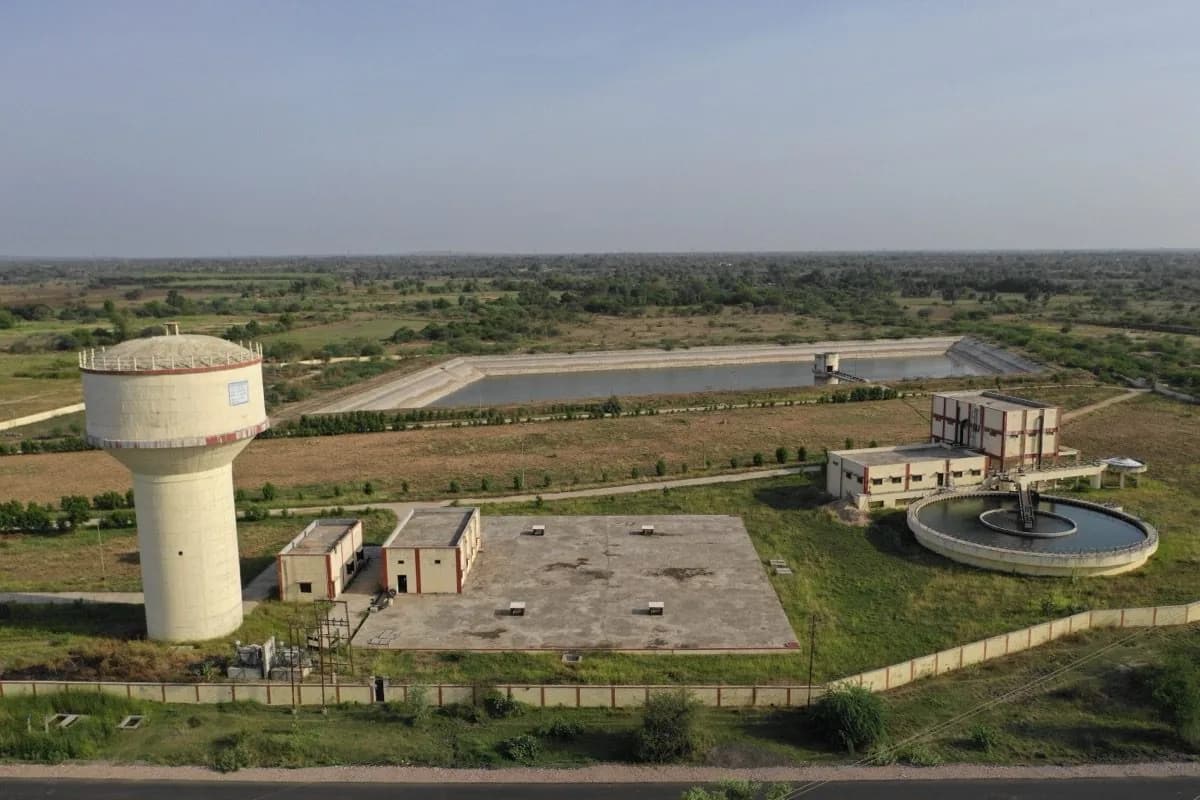
India's Water Pipeline Boom
The Jal Jeevan Mission (JJM) aims to provide Functional Household Tap Connections (FHTC) to all 19.3 crore rural households by 2024 (now extended). AMRUT 2.0 covers urban water supply. Together, these programmes represent over ₹5 lakh crore in water infrastructure investment — the largest water supply construction drive in India's history.
The civil component of every water supply scheme is pipeline construction — bulk transmission mains from the source (river, dam, WTP) to service reservoirs, and distribution networks from reservoirs to individual households.
Scale:
A typical district-level JJM scheme involves 500–2,000 km of pipeline across various diameters (from 900mm transmission main to 63mm HDPE house service connections).
VRSIPL has laid 3,000+ km of water supply pipeline across Gujarat and Madhya Pradesh, ranging from 1200mm DI trunk mains to village-level HDPE distribution networks.
Types of Pipes Used in Water Supply
Ductile Iron (DI) Pipes:
The workhorse of pressurised water transmission. Available 80mm–2000mm diameter. Push-on rubber gasket joints. Cement mortar lined internally. Suitable for pressures up to 40 bar. Used for: transmission mains, rising mains, and high-pressure distribution.
Mild Steel (MS) Pipes:
Welded steel pipes for very large diameters (1000mm–3000mm) and high-pressure applications. Internally cement mortar lined or epoxy coated, externally coated with coal tar enamel or polyethylene wrapping. Used for: bulk water transmission across long distances, pump house headers.
HDPE Pipes:
High-Density Polyethylene pipes (PE100, PN6–PN16). Available 20mm–1200mm. Joined by butt-fusion welding (no leaks possible at joints). Flexible, corrosion-proof, and ideal for distribution networks. Used for: last-mile distribution, house service connections, and rural schemes where terrain is undulating.
PVC Pipes:
Rigid PVC (uPVC) for low-pressure gravity systems and small-diameter distribution (63mm–315mm). Solvent-cement joints. Cheaper than HDPE but less flexible and brittle in cold temperatures.
GRP/FRP Pipes:
Glass Reinforced Plastic pipes for large-diameter, low-pressure applications (sewage, irrigation). Non-corrosive and lightweight.
Pipeline Construction — Step by Step
Step 1 — Route Survey and Marking:
Establish the pipeline alignment on ground using total station. Mark manhole/valve chamber locations. Identify crossings (road, railway, river, canal, gas pipeline, electric cable). Obtain crossing permissions.
Step 2 — Trench Excavation:
Excavate to specified depth (minimum cover: 1.0m for mains, 0.6m for distribution). Trench width = pipe OD + 300mm each side for working space. Use excavator for bulk excavation, manual trimming for bed preparation. In rock, use rock breaker or controlled blasting. Shore trenches deeper than 1.5m in unstable soil.
Step 3 — Bedding Preparation:
Prepare a uniform 150mm sand/gravel bed at the bottom of the trench. This ensures the pipe rests uniformly without point loads. For DI pipes, shape the bed to cradle the pipe barrel (to prevent the socket/spigot joint from bearing the weight).
Step 4 — Pipe Lowering:
Lower pipes into the trench using excavator with slings (for heavy DI/MS pipes) or manually (for HDPE/PVC). Never drop pipes into trenches.
Step 5 — Jointing:
- DI: Clean spigot and socket, lubricate rubber gasket, push home using pipe jack or excavator - MS: Manual/semi-automatic welding (SMAW or GMAW), inspect by radiography for critical joints - HDPE: Butt fusion welding using hydraulic fusion machine (heat plate, alignment, pressure, cooling cycle)
Step 6 — Backfilling:
Backfill in layers: first 300mm above pipe crown with selected fine material (no stones > 40mm), then balance with excavated material in 200mm compacted layers. Compact to 95% Proctor density (higher for road crossings).
Step 7 — Pressure Testing:
Fill the pipeline, bleed all air, and pressurise to 1.5x working pressure for minimum 2 hours. Acceptable pressure drop: < 0.1 bar in 2 hours for DI; zero drop for HDPE (fusion-welded joints are leak-free). Repair any leaks and re-test.
Step 8 — Flushing and Disinfection:
Flush the pipeline at minimum 0.6 m/s velocity. Disinfect with 50 mg/L chlorine for 24 hours. Flush again until residual chlorine < 0.5 mg/L. Take bacteriological samples before commissioning.
Special Crossings — Road, Railway, River
Pipeline crossings are the most complex (and expensive) elements of any transmission main:
Road Crossings:
Pipe laid in protective casing (steel or RCC pipe of larger diameter) under the road. Installed by open-cut (with traffic diversion) or trenchless methods (horizontal directional drilling, auger boring, pipe jacking).
Railway Crossings:
Require Railway Board permission (takes 6–12 months). Installed by open-cut during traffic block (4–6 hour window) or trenchless boring. Casing pipe is mandatory. Push-through method or auger boring commonly used.
River/Canal Crossings:
Options include: - Sub-aqueous laying (weighted pipe on river bed) - Pipe bridge (suspended from a dedicated bridge or attached to existing bridge) - HDD (Horizontal Directional Drilling) — pipe drilled 10–20m below riverbed; no disturbance to river flow - Inverted siphon under canal bed
VRSIPL has executed 200+ road crossings, 50+ railway crossings, and 30+ river crossings using both open-cut and trenchless methods.
VRSIPL's Water Pipeline Portfolio
VRSIPL has been executing water supply pipeline projects since the 1990s, with a cumulative 3,000+ km across Gujarat and Madhya Pradesh:
Key Projects:
- Waghodia Taluka Bulk Water Supply — 1200mm DI trunk main and 600+ km distribution network serving 2 lakh+ population - North Zone Vadodara Water Supply — Transmission main from WTP to 12 ESRs with 80 MLD capacity - Jal Jeevan Mission packages in rural Gujarat — FHTC to 50,000+ households - AMRUT water supply augmentation for urban local bodies
Our Capability:
- DI pipe laying: up to 1200mm diameter, 500m/day sustained rate - HDPE pipe laying: butt-fusion welding up to 630mm, 1,000m/day for distribution - MS pipe welding: coded welders for high-pressure joints with radiographic inspection - Trenchless crossings: HDD capability up to 600mm diameter, 500m length - Testing: Own pressure testing equipment and disinfection systems
Related Topics
Continue Reading
Related Articles
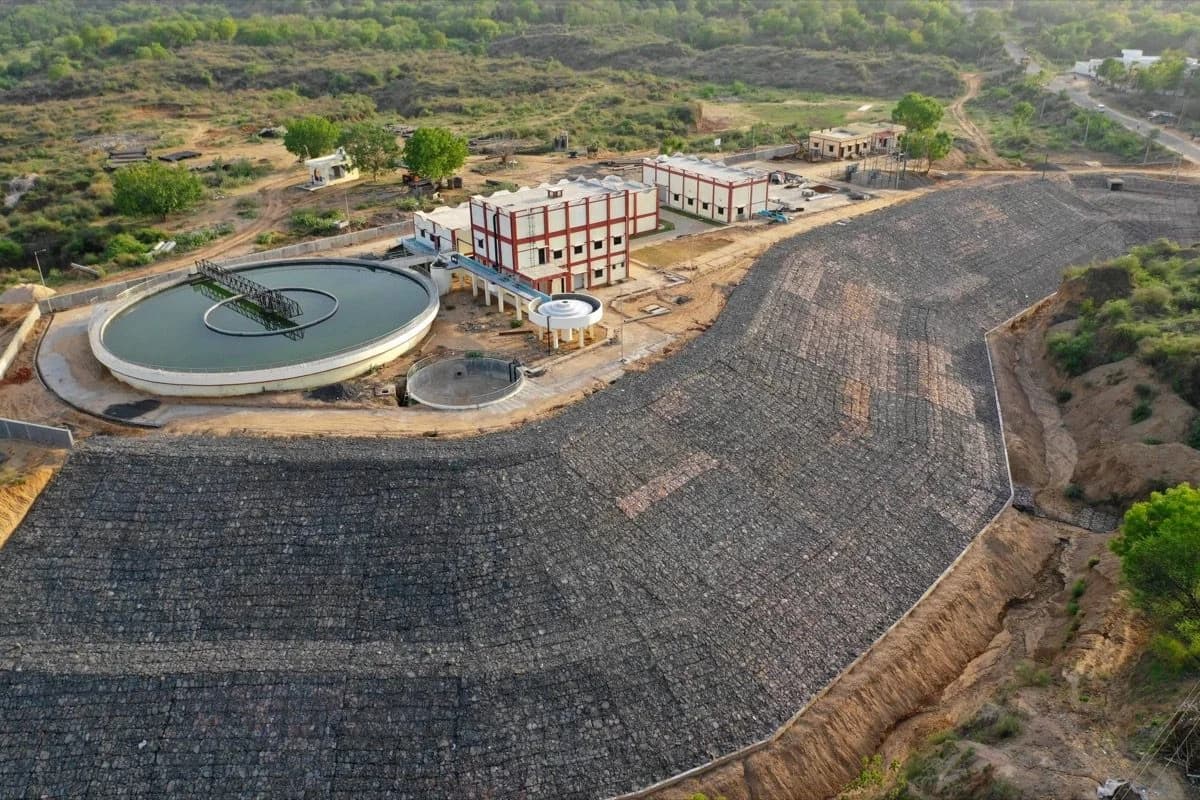
WTP Construction in India — Conventional, Packaged & UF Membrane Treatment Plants
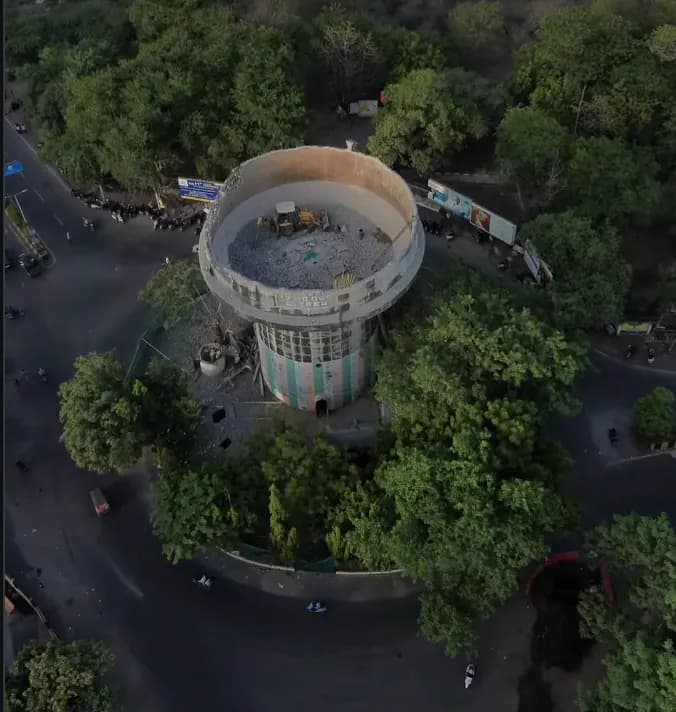
A Water Tank We Built in 1985 Is Still Too Strong to Demolish
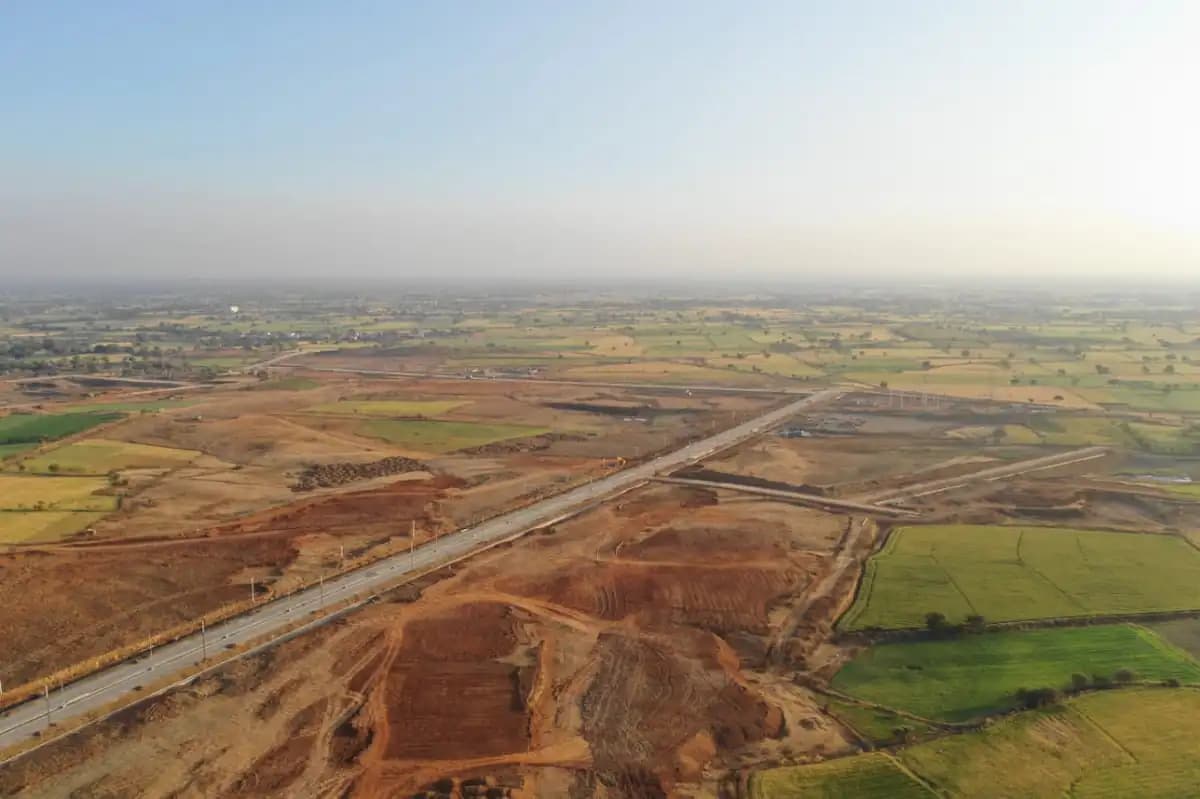
Pharma Plant Civil Construction in GIDC Gujarat — Site Development to Handover
Our Related Services
VRSIPL Services Covered in This Guide
Start Your Project
Have an Infrastructure Project?
Contact VRSIPL.
48 years of civil EPC delivery across India — WTP, STP, ETP, industrial civil, power plant, roads, and railways. Class-AA Gujarat. ISO 9001 | 14001 | 45001.