
A Tank Built to Outlast Its Own Demolition
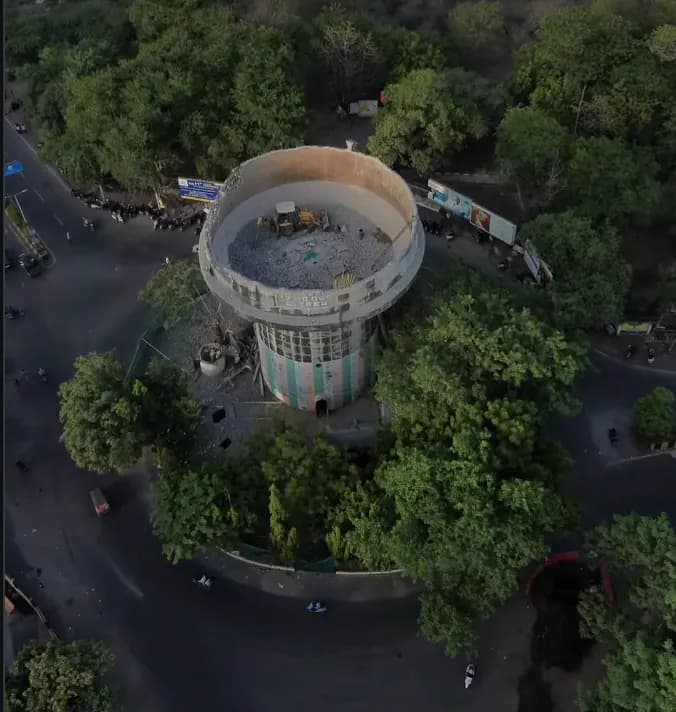
In 1985, VRSIPL constructed an elevated service reservoir (ESR) — the old Dilbahar water tank — in the Kaliyabid area of Bhavnagar, Gujarat, for the Bhavnagar Municipal Corporation. Forty-one years later, the city has outgrown it: Kaliyabid needs a taller tank to serve its expanded water supply network, so the Corporation is demolishing the old structure to rebuild at greater height.
According to a report in Gujarat Samachar's Bhavnagar Local edition (18 June 2026), the demolition — underway for over a month by that point — was still incomplete, and the Corporation extended its public traffic-diversion notice by another 15 days. The reason: the tank's reinforced concrete construction was strong enough that manual jack-hammers couldn't break through it. Demolition crews had to mount a JCB excavator directly on top of the tank to make progress, working only at night (10 PM–9 AM) given the tank's height and its location near residential areas around Victoria Park.
Why 1985-Era RCC Construction Is This Hard to Break
An elevated water tank is one of the more demanding structures in civil engineering — it has to hold a live water load at height, resist wind and seismic forces on a slender shaft, and stay watertight for decades without a single structural repair cycle most buildings get. That combination pushes contractors toward dense, well-cured, monolithic reinforced concrete rather than the lighter mixes acceptable in ordinary construction.
A well-executed water-retaining RCC structure of this era typically means: correctly proportioned aggregate and cement ratios, adequate reinforcement cover to prevent corrosion over decades, and — critically — proper curing time, since concrete that isn't cured long enough never reaches its full design strength. Get all three right, and forty years later you have a monolithic concrete mass that shrugs off equipment designed to break modern, lighter construction. That's precisely the problem Bhavnagar's demolition crew ran into.
Being Replaced for Capacity, Not for Failing
It's worth being precise about why this tank is coming down: not because it cracked, leaked, or failed a safety inspection, but because Bhavnagar's water demand has grown past what the original height and capacity were designed for in 1985. The Corporation's plan is to rebuild taller on the same site to serve the area's expanded population — a capacity upgrade, not a structural failure.
That distinction matters. A tank that needs replacing because it's undersized for a city that has grown around it, after four decades of trouble-free service, is a very different story from one that needs replacing because it failed. This one held up for 41 years and is currently giving a modern demolition crew more trouble than most buildings half its age would.
The Same Standard, Carried Forward
VRSIPL has been building water supply infrastructure in Gujarat since 1978 — intake wells, elevated and ground-level service reservoirs, treatment plants, and distribution networks, now extended across 16 states under programmes like Jal Jeevan Mission and AMRUT. The construction discipline that made the 1985 Kaliyabid tank this durable — correct mix design, adequate cover, full curing — is the same discipline behind VRSIPL's ISO 9001:2015 quality management certification today.
A water tank isn't built to be noticed. It's built to disappear into the background of a city's infrastructure for decades and simply work. When one finally comes down, and it takes a month and a JCB on the roof to do it, that's the clearest evidence a contractor can ask for.
Related Topics
Continue Reading
Related Articles
Water Supply Pipeline Construction in India — DI, MS & HDPE Pipe Laying
WTP Construction in India — Conventional, Packaged & UF Membrane Treatment Plants
Pharma Plant Civil Construction in GIDC Gujarat — Site Development to Handover
Start Your Project
Have an Infrastructure Project?
Contact VRSIPL.
48 years of civil EPC delivery across India — WTP, STP, ETP, industrial civil, power plant, roads, and railways. Class-AA Gujarat. ISO 9001 | 14001 | 45001.