
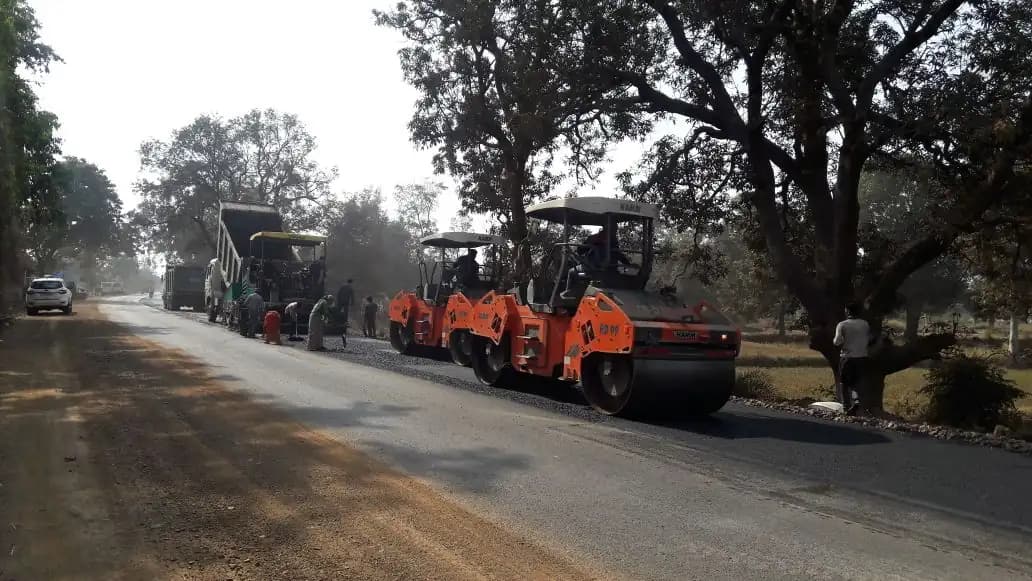
What Makes a Smart City Road Different
Traditional urban road construction was simple: excavate, lay sub-base, and pave with asphalt. Smart city roads are fundamentally different — they are underground utility corridors as much as they are roads.
A modern smart city road integrates: - Underground utility duct banks (telecom, power, CCTV, Wi-Fi fibre) - Separated stormwater drainage (no more open drains) - Underground sewerage with house connections - Underground water supply with metered connections - Cement concrete carriageway (40+ year life vs 5-year asphalt) - Paver-block footpaths with tactile guidance - Dedicated cycle tracks - LED smart street lighting with IoT sensors - Landscaped median and road-edge green zones - Street furniture (benches, bollards, signage)
This means the construction sequence is far more complex — you're building 6 underground networks before you even start the road surface.
Construction Sequence for Smart City Roads
Phase 1 — Underground Utilities (60% of project duration):
1. Excavate the entire road corridor to formation level 2. Lay stormwater drain (RCC pipe or box drain at the lowest level) 3. Lay sewerage network (parallel to stormwater but separate) 4. Lay water supply distribution main and house service connections 5. Construct multi-duct utility trench for telecom/power/fibre (pre-cast concrete duct bank or HDPE multi-duct) 6. Backfill in layers with controlled compaction 7. Construct manholes, chambers, and junction boxes at specified intervals
Phase 2 — Road Pavement:
1. Prepare sub-grade (compacted to 98% MDD — higher than highway standards due to utility trench settlement risk) 2. Lay 200mm Granular Sub-Base (GSB) 3. Lay 150mm Dry Lean Concrete (DLC) base 4. Cast 250–300mm PQC (Pavement Quality Concrete M40) using slip-form or fixed-form paver 5. Cut joints within 8 hours of casting 6. Cure for 14–28 days
Phase 3 — Footpaths, Cycle Tracks, Street Furniture:
1. Construct RCC footpath kerb and foundation 2. Lay interlocking paver blocks on sand bed 3. Install tactile pavers at crossings 4. Build cycle track with coloured surface 5. Install smart poles (combined lighting + CCTV + Wi-Fi + EV charging) 6. Landscaping and tree plantation
VRSIPL has executed smart city road projects in Gujarat including the Bhagalpur Smart City roads (Bihar) — delivering integrated underground utility + CC road + footpath packages.
Concrete Road Construction — Why Smart Cities Prefer It
Smart cities overwhelmingly specify cement concrete (rigid) pavements over bituminous (flexible) pavements. Reasons:
Design Life:
CC roads last 30–40 years vs 5–8 years for asphalt before major rehabilitation. **Utility Protection:** The rigid slab distributes concentrated loads (preventing utility trench settlement-related potholes). **Maintenance:** No annual patching, no potholes, no rutting. **Sustainability:** Lower lifecycle carbon footprint despite higher initial carbon. **Night Visibility:** Light-coloured surface improves street lighting efficiency by 30%.
Construction specifics:
- Concrete grade: M40 (PQC) with OPC 43/53 grade cement, 20mm MSA aggregate - Slab thickness: 250mm for residential roads, 300mm for arterial roads - Joint spacing: 4.5m transverse, match lane width longitudinal - Dowel bars (32mm, 500mm long) at transverse joints for load transfer - Tie bars (12mm, 750mm long) at longitudinal joints to prevent lane separation - Texture: Transverse tining for skid resistance - Curing: 14 days minimum (28 days preferred) — the most critical quality parameter
Stormwater Drain Construction
Modern smart city stormwater management replaces open naalas with an engineered underground system:
Components:
- RCC pipe drains (300mm–1200mm) or box drains (1m x 1m to 3m x 2m) along both road sides - Catch basins (road-level grated inlets) every 30–50m - Manholes at every junction, bend, and at maximum 30m intervals - Outfall structures discharging to natural drains/rivers - Retention/detention ponds for peak flow management
Design Basis:
5-year return period rainfall for minor drains, 25-year for trunk drains. Rational method or SCS curve number method for runoff estimation.
Construction Challenges:
- Deep excavation (3–5m) in congested urban areas with existing utilities - Dewatering in high water table zones - Traffic management during construction - House connection integration
VRSIPL's stormwater drain construction experience spans 200+ km of underground drainage across urban projects.
Related Topics
Continue Reading
Related Articles
National Highway Construction Process in India — From DPR to Ribbon Cutting
Road Construction Cost Per Km in India (2025–26) — Two-Lane to Expressway
Pharma Plant Civil Construction in GIDC Gujarat — Site Development to Handover
Our Related Services
VRSIPL Services Covered in This Guide
Start Your Project
Have an Infrastructure Project?
Contact VRSIPL.
48 years of civil EPC delivery across India — WTP, STP, ETP, industrial civil, power plant, roads, and railways. Class-AA Gujarat. ISO 9001 | 14001 | 45001.