
The Highway Construction Lifecycle in India
National highway construction in India follows a well-defined lifecycle governed by MoRTH (Ministry of Road Transport & Highways) specifications and IRC (Indian Roads Congress) standards. The process typically spans 24–36 months from contract award to completion for a two-lane to four-lane project. Understanding this lifecycle helps project owners, engineers, and the public appreciate the engineering complexity behind every kilometre of smooth road.
The lifecycle consists of seven major phases: Detailed Project Report (DPR) preparation, tendering and contract award, land acquisition and utility shifting, site mobilisation, earthwork and sub-grade preparation, pavement construction, and finishing works with quality testing.
Phase 1: Detailed Project Report (DPR) and Survey
Every highway project begins with a DPR — a comprehensive document that establishes the project's technical, financial, and environmental viability. The DPR includes:
Topographic Survey:
Total station and DGPS-based survey of the entire corridor, establishing existing ground levels, cross-sections at 20-metre intervals, and identifying all structures (culverts, bridges, ROBs) along the alignment.
Geotechnical Investigation:
Bore holes at 500-metre intervals to determine sub-soil conditions — critical for pavement design and embankment stability. The California Bearing Ratio (CBR) of subgrade soil determines the thickness of each pavement layer.
Traffic Survey:
7-day classified traffic counts at multiple locations to establish design traffic in terms of cumulative million standard axles (msa) over the design life (typically 15–20 years).
Pavement Design:
Based on CBR and design traffic, the pavement composition is designed per IRC:37 (flexible) or IRC:58 (rigid). A typical four-lane highway might need 500mm granular sub-base, 250mm wet mix macadam base, 100mm dense bituminous macadam, and 40mm bituminous concrete wearing course.
Hydraulic Design:
Cross-drainage structures (culverts, minor bridges, major bridges) are designed based on catchment area, rainfall intensity, and flood frequency analysis.
Phase 2: Tendering and EPC Contract Award
NHAI and state PWDs award highway contracts through competitive bidding. The two main contract models are:
EPC (Engineering, Procurement, Construction):
The contractor designs and builds the highway for a fixed lump sum. Payment is milestone-based. The contractor bears the construction risk. This model is used for most Bharatmala projects.
HAM (Hybrid Annuity Model):
The government pays 40% during construction and 60% as annuity payments over 15 years. The contractor arranges financing for the remaining 60% during construction.
Qualification criteria
for NHAI EPC contracts typically require: annual turnover of 1.5x–2x the estimated cost, net worth of 0.25x the estimated cost, and experience of completing similar road works of 0.5x–0.8x the project value in the past 7 years.
VRSIPL has been qualifying and executing NHAI and MoRTH highway projects since the early 2000s, with experience across four-laning, six-laning, and two-lane with paved shoulders configurations.
Phase 3: Site Mobilisation and Land Acquisition
Once the contract is awarded, the EPC contractor mobilises within 30–60 days. Mobilisation involves:
- Setting up site offices, labour camps, and material storage yards - Deploying a hot mix plant (capacity 60–120 TPH), a WMM plant (200–300 TPH), batch mix/drum mix plants, and stone crushers - Procuring earth-moving equipment: excavators, bulldozers, motor graders, vibratory rollers, tippers - Establishing a site laboratory for daily quality testing
Land acquisition
is typically the biggest bottleneck. NHAI handles land acquisition under the RFCTLARR Act 2013, but the contractor often faces partial stretches where land is not yet handed over. Smart contractors (like VRSIPL) work on available stretches first and plan their work programme to accommodate phased land handover.
Phase 4: Earthwork — The Foundation of Every Highway
Earthwork is the largest single activity in highway construction, often representing 25–35% of the project cost. It involves:
Embankment Construction:
Most Indian highways are built on embankments raised 1.5–6 metres above the surrounding terrain to maintain flood-free road level. Earth is borrowed from designated borrow areas, transported by tippers, spread in layers of 200–300mm, and compacted to 97% Modified Proctor Density using vibratory rollers.
Cutting:
In hilly terrain, rock cutting and controlled blasting create the road formation. Cut material is often used as embankment fill elsewhere on the project (balanced earthwork).
Sub-grade Preparation:
The top 500mm of the embankment (the sub-grade) must achieve a minimum CBR of 8% and be compacted to 100% MDD. This layer directly supports the pavement and determines its long-term performance.
Quality Testing:
Every 200 metres, field density tests (using sand replacement method or nuclear density gauge) verify compaction. Laboratory CBR tests confirm sub-grade strength. Any failure requires re-compaction or soil improvement.
Phase 5: Pavement Construction — Layer by Layer
A highway pavement is built in carefully sequenced layers, each serving a specific structural function:
Granular Sub-Base (GSB):
200–500mm of graded stone aggregate (conforming to MoRTH Table 400-1), spread by motor grader and compacted by vibratory roller. This layer provides drainage and distributes loads to the sub-grade.
Wet Mix Macadam (WMM):
200–250mm of crusher-run aggregate mixed with optimum moisture, laid by paver/motor grader and compacted. This is the primary load-distributing layer.
Dense Bituminous Macadam (DBM):
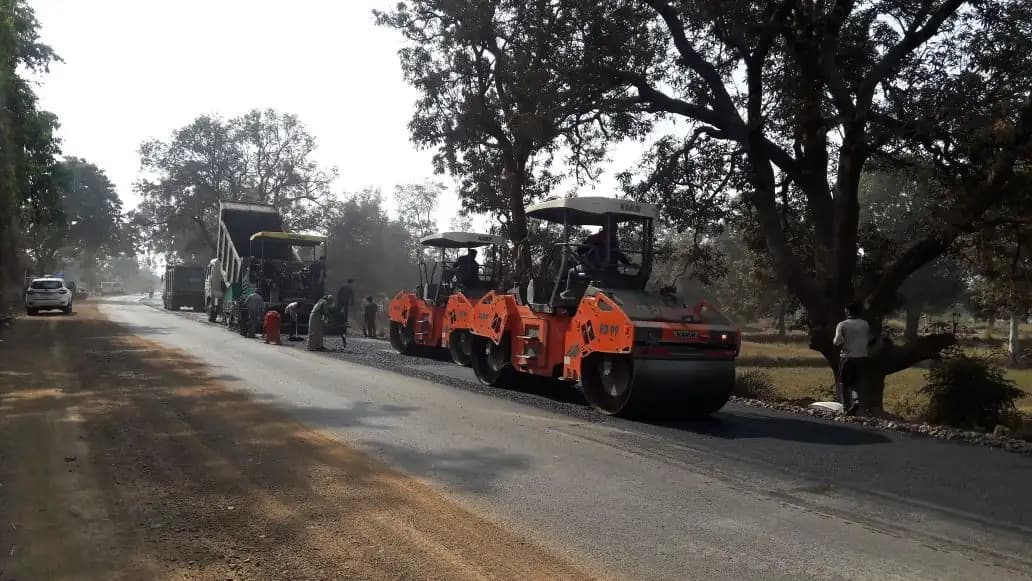
100–150mm of bitumen-bound aggregate laid by a sensor paver finisher at precisely controlled temperature (130–160°C). Compacted by tandem and pneumatic tyre rollers while hot.
Bituminous Concrete (BC):
40–50mm wearing course — the surface you drive on. Uses polymer-modified bitumen (PMB-40) for high-traffic corridors. Laid by sensor paver with automatic slope and level control.
For Rigid Pavements (Cement Concrete):
300mm PQC (Pavement Quality Concrete) of M40 grade is laid using a slip-form paver over a DLC (Dry Lean Concrete) base. Joints are cut at 4.5m intervals within 24 hours of casting.
VRSIPL operates sensor pavers, hot mix plants, and WMM plants that enable continuous paving of 400–600 metres per day on four-lane projects.
Phase 6: Cross-Drainage and Bridge Construction
A typical 50-km highway stretch may require 30–80 cross-drainage structures:
Pipe Culverts:
NP3/NP4 class RCC pipes (900mm–1800mm dia) for minor streams with catchment under 50 hectares.
Box Culverts:
Single or multi-cell RCC box structures (2m x 2m to 6m x 4m) for moderate flows.
Minor Bridges:
6m–30m span RCC/PSC structures crossing seasonal streams.
Major Bridges:
30m+ span structures crossing rivers — typically prestressed concrete girders on pile foundations.
ROBs/RUBs:
Railway over-bridges and underpasses at railway crossings — these require Railway Board approval and are often on the project's critical path.
VRSIPL has constructed 200+ cross-drainage structures on highway projects, including major bridges spanning up to 300 metres.
Quality Testing Standards for Highway Construction
MoRTH specifications mandate rigorous quality testing at every stage:
- **Embankment:** Field density test every 200m, CBR every 500m - **GSB/WMM:** Gradation test every 200 cum, field density every 500m - **Bituminous layers:** Marshall Stability test every 100 tonnes, core extraction every 500m for thickness and density - **Concrete:** Cube testing every 50 cum (7-day and 28-day strength) - **Surface quality:** Roughness measured by Bump Integrator (BI value < 2000mm/km for new construction)
A dedicated site laboratory with trained technicians is mandatory for every highway project. VRSIPL's NABL-affiliated laboratories ensure zero non-conformances during NHAI quality audits.
FAQ — Highway Construction in India
Q: How much does it cost to build 1 km of national highway in India?
Cost varies from ₹8–15 crore/km for two-lane rural highways to ₹25–40 crore/km for four-lane expressways (excluding land cost). Six-lane access-controlled expressways can cost ₹60–100 crore/km.
Q: How long does it take to build a 50 km highway?
A typical four-lane EPC project of 50 km takes 24–30 months from appointed date to completion, assuming timely land handover and utility shifting.
Q: What equipment does a highway contractor need?
Minimum fleet: 2 excavators, 4 tippers per km under construction, 1 hot mix plant (80+ TPH), 1 WMM plant (200+ TPH), 2 sensor pavers, tandem and PTR rollers, motor grader, and a site laboratory.
Q: What is the difference between EPC and BOT highway contracts?
In EPC, the government pays during construction; in BOT, the contractor collects toll for 15–25 years to recover investment. EPC has lower risk for contractors and is now the dominant model under Bharatmala.
Related Topics
Continue Reading
Related Articles
Smart City Road Construction in India — Utilities, Stormwater & Concrete Roads
Road Construction Cost Per Km in India (2025–26) — Two-Lane to Expressway
Pharma Plant Civil Construction in GIDC Gujarat — Site Development to Handover
Our Related Services
VRSIPL Services Covered in This Guide
Start Your Project
Have an Infrastructure Project?
Contact VRSIPL.
48 years of civil EPC delivery across India — WTP, STP, ETP, industrial civil, power plant, roads, and railways. Class-AA Gujarat. ISO 9001 | 14001 | 45001.