
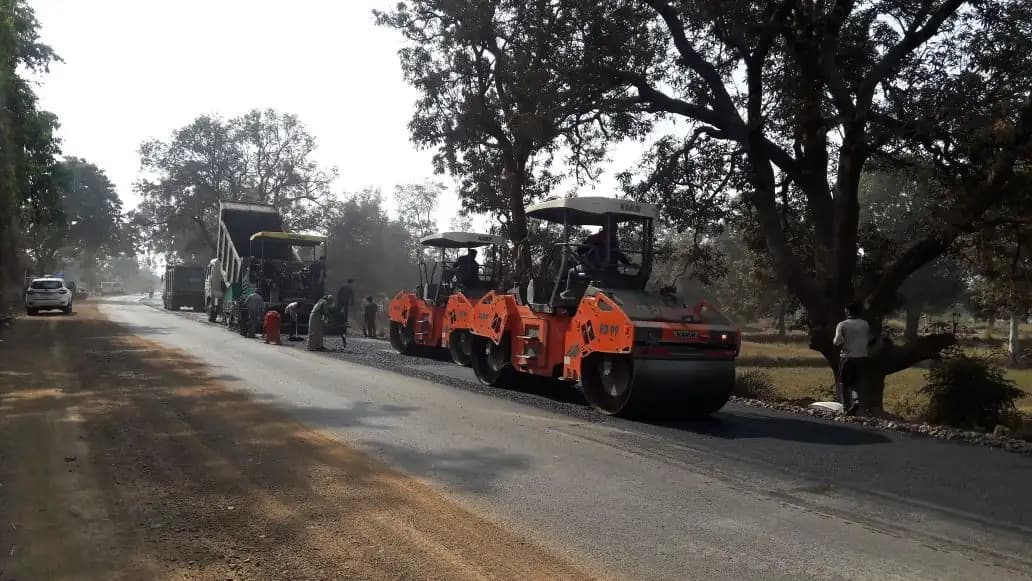
Road Construction Costs by Type (2025–26 Prices)
1. Rural Roads (PMGSY Standard):
- 3.75m carriageway, single lane - Cost: ₹80 lakh – ₹1.5 crore/km - Components: Earthwork (30%), GSB + WBM (25%), Bituminous surface (20%), CD works (15%), Others (10%)
2. Two-Lane with Paved Shoulders (NH Standard):
- 7.0m carriageway + 1.5m paved shoulders each side - Cost: ₹6–12 crore/km (plain terrain), ₹15–25 crore/km (hilly terrain) - Components: Earthwork (25%), Pavement (30%), Structures (20%), Land (15%), Others (10%)
3. Four-Lane Divided Highway:
- 2 × 7.0m carriageways with median, hard shoulders - Cost: ₹15–30 crore/km (plain terrain, excluding land) - Add ₹5–15 crore/km for land acquisition in agricultural areas - Major cost drivers: Earthwork for high embankments, structures frequency, terrain difficulty
4. Six-Lane Highway:
- 2 × 10.5m carriageways with wide median - Cost: ₹25–45 crore/km (excluding land) - Used for high-traffic trunk routes (DFC, golden quadrilateral upgrades)
5. Access-Controlled Expressway:
- 6–8 lanes, grade-separated interchanges, no at-grade crossings - Cost: ₹60–100+ crore/km (all-inclusive) - Major cost items: Interchanges (₹50–200 crore each), toll plazas, service roads, fencing, ITS (Intelligent Transportation Systems)
6. Urban Elevated Corridor:
- Cost: ₹150–250 crore/km - Entirely on elevated structure (pile + pier + precast deck) - Includes ramps, interchanges, service roads below
Cost Breakdown — What Goes Into Each Kilometre
A detailed cost breakdown for a typical four-lane highway (₹20 crore/km):
| Component | % of Cost | ₹ Crore/km | |-----------|-----------|-------------| | Earthwork (embankment, sub-grade) | 20% | 4.0 | | Pavement (GSB + WMM + DBM + BC) | 25% | 5.0 | | Cross-drainage structures | 18% | 3.6 | | Major bridges | 12% | 2.4 | | Road furniture & safety works | 5% | 1.0 | | Utility shifting | 5% | 1.0 | | Environmental mitigation | 3% | 0.6 | | Contractor margin & overheads | 12% | 2.4 |
Factors that increase cost:
- Hilly terrain: 2–3x (due to cutting, retaining walls, tunnels) - Marshy/flood-prone areas: 1.5–2x (ground improvement, higher embankments) - Urban stretches: 2–5x (utilities, traffic management, elevated sections, land) - High structure density: Each major bridge adds ₹5–50 crore - Rigid (concrete) pavement: 30–40% premium over flexible (bituminous)
Cost trends (2020–2026):
Construction costs have increased 25–35% over 5 years due to cement (+40%), steel (+50%), bitumen (+30%), and diesel (+25%) price increases. However, productivity improvements (mechanisation, better project management) have partially offset material inflation.
How VRSIPL Estimates and Controls Costs
VRSIPL's four-decade experience provides us with granular cost data across terrain types, materials, and geographies. Our estimation approach:
Bottom-Up Estimation:
- Detailed quantity take-off from DPR/design drawings - Current market rates for materials (updated monthly) - Equipment costing based on owned fleet + hired rates - Labour rates by geography (vary 30–50% between states) - Sub-contractor rates for specialist items
Cost Control During Execution:
- Material reconciliation (actual vs estimated consumption) - Equipment utilisation tracking (minimum 70% target) - Productivity monitoring (cum/day, sq.m/day benchmarks) - Value engineering without compromising quality
Our Competitive Edge:
- Own equipment fleet (no rental overhead for core machinery) - Bulk material procurement (cement, steel, bitumen) with annual rate contracts - Experienced workforce reducing rework and wastage - 48 years of cost data across 500+ projects for accurate estimation
VRSIPL's executed project cost consistently comes within 3–5% of estimated cost — a testament to accurate estimation and disciplined execution.
Related Topics
Continue Reading
Related Articles
National Highway Construction Process in India — From DPR to Ribbon Cutting
Smart City Road Construction in India — Utilities, Stormwater & Concrete Roads
Pharma Plant Civil Construction in GIDC Gujarat — Site Development to Handover
Start Your Project
Have an Infrastructure Project?
Contact VRSIPL.
48 years of civil EPC delivery across India — WTP, STP, ETP, industrial civil, power plant, roads, and railways. Class-AA Gujarat. ISO 9001 | 14001 | 45001.