
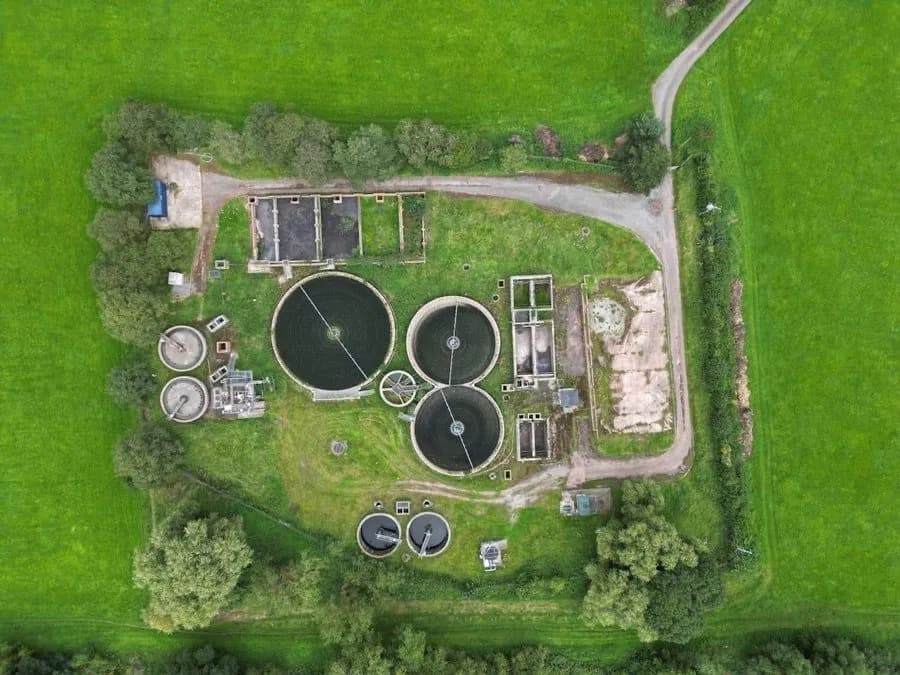
India's Sewage Treatment Gap
India's urban areas generate approximately 72,000 MLD (million litres per day) of sewage. Against this, the installed treatment capacity is only 36,000 MLD — and many existing STPs operate below capacity or are non-functional. This means over 50,000 MLD of raw sewage enters India's rivers and water bodies daily.
The National Mission for Clean Ganga (NMCG), AMRUT 2.0, and Smart Cities Mission are funding thousands of new STPs across India. The STP construction market is estimated at ₹50,000+ crore over the next decade.
For every STP, civil construction represents 50–60% of the project cost. The civil contractor builds all the tanks, channels, pump houses, and ancillary buildings — the 'concrete skeleton' that houses the treatment equipment.
VRSIPL has constructed STPs ranging from 5 MLD to 100 MLD across Gujarat and Madhya Pradesh.
STP Technologies — SBR vs MBBR vs MBR
The treatment technology determines the civil layout and tank dimensions:
SBR (Sequencing Batch Reactor):
Batch process — fill, react, settle, decant in the same tank. Requires 2–4 large rectangular tanks operating in alternating cycles. - Civil requirement: Large rectangular RCC tanks (depth 4–6m), inlet works, equalization tank, sludge handling - Footprint: Moderate (no separate clarifier needed) - Best for: 5–50 MLD urban STPs
MBBR (Moving Bed Biofilm Reactor):
Continuous flow through tanks with plastic bio-media (carriers). Requires aeration tank + separate clarifier. - Civil requirement: Rectangular aeration tanks (with media retention screens), separate secondary clarifier (circular), sludge thickener - Footprint: Slightly larger than SBR (needs clarifier) - Best for: 10–100+ MLD, upgradable capacity
MBR (Membrane Bioreactor):
Biological treatment + ultrafiltration membranes replace the clarifier. Produces very high-quality effluent. - Civil requirement: Compact aeration tanks (can be deeper — 5–7m), membrane tank, no separate clarifier - Footprint: Smallest (40–50% less than conventional) - Best for: Space-constrained sites, reuse applications, 1–50 MLD
Conventional ASP (Activated Sludge Process):
Oldest technology — aeration tank + secondary clarifier + sludge recirculation. - Civil requirement: Largest footprint — separate aeration tank, clarifier, and sludge handling - Being replaced by SBR/MBBR in new projects
STP Civil Construction Scope
A typical 20 MLD STP involves the following civil structures:
1. Inlet Works:
- Inlet chamber with screening channel (for coarse and fine screens) - Grit chamber (aerated or vortex type) — RCC channel with grit collection hopper - Flow measurement chamber (Parshall flume)
2. Equalization Tank:
- RCC tank (typically 4–6 hour detention) to balance flow variations - Depth: 4–5m, with submersible mixer pockets in base slab
3. Biological Treatment Tanks:
- SBR tanks: Rectangular, 5–6m water depth, 40–80m length, with decanters and aeration grid - MBBR tanks: Rectangular with screen walls for media retention - Internal baffles, channels, and weirs as per process design
4. Secondary Clarifier (for MBBR/ASP):
- Circular RCC tank, 3–4m side water depth - Central feed column, peripheral weir, scraper bridge pocket - Sludge hopper in centre
5. Tertiary Treatment:
- Chlorine contact tank (serpentine channel, 30-minute detention) - Pressure sand filter (if specified) — RCC filter shell - Activated carbon filter tank
6. Sludge Handling:
- Sludge thickener (circular tank) - Sludge digester (for large STPs) - Centrifuge/filter press building - Sludge drying beds (RCC/brick construction)
7. Ancillary Buildings:
- Pump house (raw sewage, process, sludge) - Electrical sub-station and MCC room - Blower room (for aeration system) - Chemical storage and dosing room - Admin block, laboratory, operator room
8. External Works:
- Approach road, internal roads - Boundary wall, gate, security cabin - Landscaping, green belt - Interconnecting pipelines and channels between units
RCC Tank Construction for STPs — Watertightness is Critical
STP tanks must be absolutely watertight — any leakage means untreated sewage contaminating groundwater. Critical requirements:
Concrete Grade:
Minimum M30 for all liquid-retaining structures. W/C ratio limited to 0.45. Use OPC 53 grade or PPC cement.
Crack Width Control:
Maximum allowable crack width: 0.2mm (IS 3370 Part 2). This requires close spacing of reinforcement and controlled concrete placement.
Construction Joints:
Horizontal construction joints are inevitable in deep tanks (cannot pour 5m height in one go). Treat joints with water-stop (PVC or swellable rubber type) cast into the pour. Surface preparation: green-cutting (wire brushing within 6 hours of pour) or roughening by sand blasting.
Water-stop at Joints:
225mm PVC centre-bulb water-stop at all construction joints and expansion joints. Must be continuous — any break allows leakage.
Curing:
Minimum 14 days for liquid-retaining structures. Ponding on base slab, wet hessian on walls. Inadequate curing is the number-one cause of tank leakage.
Hydraulic Testing:
Fill each tank to operating level and hold for 7 days. Acceptable water loss: < 1/500th of tank capacity per 24 hours (IS 3370). Any failure requires repair and re-testing.
VRSIPL's STP construction teams specialise in watertight RCC tank construction with zero-leakage track record across 50,000+ cum of STP tank volume.
Related Topics
Continue Reading
Related Articles
Pharma Plant Civil Construction in GIDC Gujarat — Site Development to Handover
Choosing an STP Civil Contractor in India — Municipal & Industrial Guide 2026
ETP and ZLD Civil Works for Chemical Industries in GIDC — Complete Guide
Our Related Services
VRSIPL Services Covered in This Guide
Start Your Project
Have an Infrastructure Project?
Contact VRSIPL.
48 years of civil EPC delivery across India — WTP, STP, ETP, industrial civil, power plant, roads, and railways. Class-AA Gujarat. ISO 9001 | 14001 | 45001.