ETP Compliance for Chemical Industries in Gujarat
Chemical industries in Gujarat — particularly those operating in GIDC estates at Ankleshwar, Panoli, Vapi, Vatva, Naroda, and Dahej — operate under some of the strictest effluent treatment regulations in the country. The combination of GPCB (Gujarat Pollution Control Board) enforcement, NGT (National Green Tribunal) directives, and CPCB (Central Pollution Control Board) ZLD mandates has created a regulatory environment where ETP civil works are no longer optional: they are existential for continued operation.
GPCB enforces GIDC industrial unit compliance through regular effluent sampling, surprise inspections, and online continuous effluent monitoring (OCEMS) systems that transmit real-time effluent quality data to GPCB servers. Any deviation from consent conditions triggers immediate show cause notices, and repeat violations can result in plant closure orders enforced by GIDC.
The NGT has issued sweeping directives on ZLD (Zero Liquid Discharge) for industries in critically polluted zones. Ankleshwar and Vatva industrial areas have been designated Critically Polluted Areas under CPCB's Comprehensive Environmental Pollution Index (CEPI), which imposes additional obligations on industries — including ZLD mandates for all new and expanding units.
For chemical manufacturers in these clusters, the implication is stark: if your ETP does not work — whether due to poor civil construction, inadequate design, or equipment failure — you face plant closure, financial penalties, and potential criminal liability under the Environment Protection Act. This is why ETP civil construction quality matters profoundly: a leaking equalization tank, an under-capacity sludge drying bed, or an improperly built bund wall can render an otherwise functional ETP non-compliant.
Civil Structures in an Industrial ETP
An industrial ETP for a chemical plant in GIDC typically contains the following civil structures, each of which demands specialised civil engineering knowledge:
Equalization Tank:
The first and often largest civil structure — a large RCC tank that buffers the highly variable flow and pollutant load from batch chemical processes. Equalization tanks for large chemical plants can be 500–2,000 cubic metres in volume. They require chemical-resistant lining (acid-resistant brick with acid-proof cement mortar, or coal tar epoxy coating) because chemical plant effluent often contains solvents, acids, and alkalis that attack ordinary concrete.
Flash Mixing Chamber:
A small, rapid-mix chamber where pH correction chemicals (lime/acid) and coagulants (alum, FeCl3, PAC) are dosed. Civil requirement: compact RCC chamber with submerged mixer mounting provisions, dosing tank plinths.
Clariflocculator or Tube Settler:
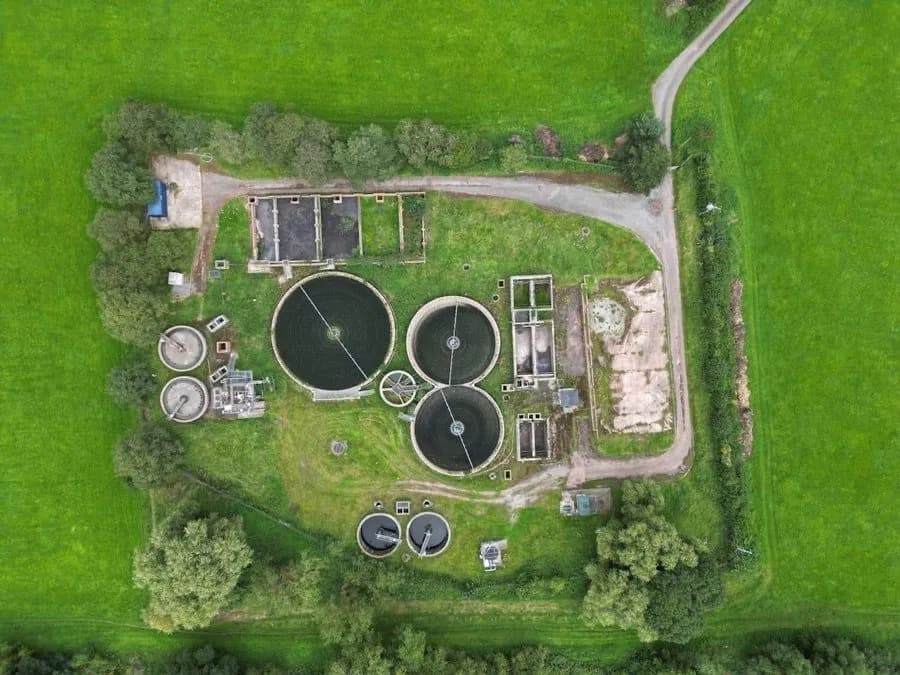
The primary treatment unit where suspended solids and heavy metals precipitate after coagulation and flocculation. The clariflocculator is a circular RCC tank (typically 8–20 m diameter, 3–5 m deep) with a central rotating sludge collection mechanism. Civil requirement: circular tank IS:3370 design, central steel column foundation, precise level weir, sludge hopper bottom.
Activated Sludge Tank or SBR/MBBR:
For biologically treatable effluent, the biological treatment tank is the largest structure in the ETP. Chemical plant ETPs with high-strength organic effluent often use dual-stage or high-MLSS biological systems. MBBR (Moving Bed Biofilm Reactor) systems require screen frames embedded in the concrete walls — the civil contractor must co-ordinate exact screen dimensions with the equipment vendor before concrete is poured.
Secondary Clarifier:
Circular settling tank for separation of biological sludge from treated effluent. Similar civil requirements to the clariflocculator.
Pressure Sand Filter and Activated Carbon Filter Structures:
Multi-media pressure filters (PSF) and activated carbon filters (ACF) are housed on a filter gallery — a RCC platform with embedded pipe sleeves, drain sumps, and a common backwash water collection trough. Civil requirement: precise pipe sleeve alignment, access platforms, backwash water channel.
Sludge Thickener and Filter Press Room:
Sludge from primary and secondary treatment is thickened in a gravity sludge thickener before dewatering on a filter press. The filter press room must have a heavy-duty RCC floor (for filter press load), overhead monorail or crane for filter press plate handling, drainage channels, and sludge cake loading bay with truck access.
Chemical Dosing Area:
Multiple chemical dosing systems (lime, FeCl3, poly electrolyte, acid/alkali) require a dedicated dosing area with acid-resistant tile flooring, bund wall to contain spills, ventilation for chemical fume containment, and overhead lifting provisions for chemical drum handling.
MEE Building (for ZLD):
Multi-Effect Evaporators are heavy industrial equipment — the civil building must handle very high floor loads (often 15–25 kN/m²), provide high bay height (10–14 m) for evaporator bodies, include monorail crane provisions for maintenance, and incorporate heavy structural frames for evaporator support. This is among the most demanding civil structures in an industrial ETP.
Lab Building and Control Room:
The operator's QC laboratory (for effluent testing) and plant control room (for SCADA and operator workstation) must be neat, functional civil buildings with anti-vibration flooring near analytical instruments, proper air-conditioning civil provisions, and clean environment.
What Is CETP and Why It Matters for Small Industry Clusters
CETP — Common Effluent Treatment Plant — is a shared ETP facility serving multiple small industries within a GIDC cluster. CETPs are particularly important in clusters like Ankleshwar GIDC, Vatva GIDC, and Vapi GIDC, where hundreds of small chemical and dye manufacturers cannot individually afford to build and operate a full ETP to GPCB standards.
The CETP model works as follows: individual member industries pre-treat their effluent to meet the inlet standards of the CETP (typically reducing TSS and pH to acceptable levels), then discharge into a common collection network. The CETP operator (typically a cooperative or Special Purpose Vehicle) collects this combined effluent, treats it to GPCB discharge standards, and disposes of treated water and sludge.
CETP civil works are large-scale and include: collection chambers and pumping stations distributed across the industrial estate, a central ETP receiving large volumes (often 2–10 MLD) from multiple industries, primary treatment blocks (equalization, neutralization, primary clarification), secondary biological treatment, tertiary polishing (sand filters, activated carbon), sludge handling (sludge thickeners, filter press building), and in ZLD-mandated clusters, MEE/ATFD facilities.
VRSIPL has executed CETP civil works in GIDC zones, including collection chamber networks, main ETP civil structures, and sludge handling facilities. Our understanding of multi-industry effluent variability — and the need for robustly designed equalization and neutralization civil — makes us a reliable CETP civil contractor.
ZLD — Zero Liquid Discharge Civil Requirements
Zero Liquid Discharge (ZLD) is the most challenging civil scope in industrial wastewater management. ZLD means the plant discharges zero liquid effluent to the environment — all treated water is either reused in the process or evaporated, leaving only solid salt or concentrated brine for disposal.
The civil requirements for ZLD go well beyond a standard ETP:
MEE (Multi-Effect Evaporator) Building:
This is the centrepiece of most ZLD systems. An MEE typically requires a building 12–18 m high with floor loads of 15–30 kN/m² for the evaporator bodies, condensate collecting vessels, and heat exchangers. The structural design requires heavy RCC frames or steel portal frames with heavy concrete bases. Anti-vibration isolation is essential because MEE vibration can affect analytical instruments elsewhere on the site.
Agitated Thin Film Dryer (ATFD) Civil:
For very high TDS effluent, an ATFD downstream of the MEE concentrates the brine to near-dry salt. ATFD civil requires heavy-duty floor slabs, elevated platforms for condensate collection, and enclosed dust containment civil.
Evaporation Pond:
For large volumes of low-TDS concentrated reject, solar evaporation ponds are a lower-cost ZLD option. The civil work involves earthwork to form embankment dyke walls (compacted earth bund, typically 1.5–2.5 m high), lining of the pond base and sides with HDPE geomembrane (civil contractor installs liner anchorage trench), and a collection sump for accumulated salt removal.
Salt Storage Area:
Dried salt from MEE or ATFD must be stored in a dedicated, impervious RCC storage bunker with drainage collection. This prevents salt leaching into groundwater.
Reject Brine Recirculation Civil:
In some ZLD configurations, concentrated brine is recirculated to the process (e.g., as process water for certain chemical reactions). Civil work includes brine storage tanks, recirculation pump pits, and pipeline trenches.
VRSIPL's ZLD civil experience includes MEE building construction for pharmaceutical and dye manufacturers in GIDC estates, evaporation pond dyke construction, and the full tertiary civil scope that precedes the ZLD system.
VRSIPL's ETP Civil Work Across GIDC Estates
VRSIPL has executed 25+ industrial ETP civil projects across GIDC estates and private industrial sites in Gujarat and Maharashtra. Our ETP civil portfolio spans a wide range of industries and effluent types:
Industries served:
Pharmaceutical (API, bulk drug, formulation), reactive dye and azo dye manufacturers, specialty chemical and fine chemical plants, FMCG (detergent, personal care, food processing), petrochemical ancillary, and textile processing industries.
GIDC zones covered:
Ankleshwar, Panoli, Jhagadia, Dahej, Bharuch district GIDC estates; Vatva, Naroda, Bavla in Ahmedabad district; Sachin GIDC in Surat; Vapi and Umbergaon in South Gujarat; and MIDC zones in Maharashtra.
Scale range:
VRSIPL has executed ETP civil works ranging from small 50–200 KLD industrial ETPs for single-product pharma plants to large 1–5 MLD ETPs for multi-product chemical manufacturers and CETP facilities.
Notable capabilities:
Watertight RCC tank construction with IS:3370 compliance; acid-resistant brick lining in equalization and neutralization tanks; MEE building construction with heavy slab and high-bay structural frame; evaporation pond dyke construction with HDPE liner installation; filter press room with overhead crane runway beam; GPCB inspection support and compliance documentation.
Every ETP civil project delivered by VRSIPL has obtained GPCB CTO (Consent to Operate) — our track record on regulatory compliance is 100%.
FAQ — ETP and ZLD Civil Works in GIDC Gujarat
Q1: How much does ETP civil construction cost for a 500 KLD chemical plant ETP in GIDC?
For a 500 KLD industrial ETP serving a chemical plant in GIDC — including equalization tank, primary treatment, biological treatment, secondary clarifier, sludge handling, chemical dosing area, lab, and control room — civil cost typically ranges from ₹80 lakh to ₹1.5 crore, depending on tank volumes, effluent characteristics, and the specific unit processes required. ZLD additions (MEE building, evaporation pond) add substantially to civil cost — typically ₹50 lakh to ₹2 crore more, depending on ZLD system scale. VRSIPL provides detailed civil estimates after reviewing the process design basis.
Q2: How long does VRSIPL take to complete ETP civil works for an industrial unit?
For a standalone industrial ETP (500 KLD–2 MLD range), civil construction takes 4–8 months from site handover. For larger CETPs or ETP+ZLD packages, expect 10–18 months. VRSIPL prioritises the critical path structures (equalization tank, primary treatment) to allow concurrent equipment procurement and erection activity.
Q3: Can VRSIPL help with GPCB CTE/CTO documentation for ETP civil works?
VRSIPL provides full civil drawings, material specifications, and construction methodology documentation required for GPCB Consent to Establish (CTE) applications. During construction, we maintain quality records (concrete test reports, watertightness test results, material certificates) that form the basis of the GPCB CTO application. We have extensive experience co-ordinating with GPCB-approved ETP designers and pollution consultants.
Q4: Does VRSIPL handle acid-resistant lining for chemical plant ETP tanks?
Yes. VRSIPL's ETP civil scope includes acid-resistant brick lining (using acid-proof cement and appropriate brick type) for equalization tanks, neutralization chambers, and other structures in contact with acidic or alkaline chemical effluent. We also apply epoxy coating systems (coal tar epoxy, glass-flake epoxy) where chemical resistance is required without brick lining. Material selection is based on the specific chemicals present in the client's effluent.
Q5: Is VRSIPL registered to execute ETP civil works under government CETP projects?
Yes. VRSIPL holds Class-AA registration with the Government of Gujarat Public Works Department, which qualifies us for government-funded CETP civil works tendered by GIDC, GPCB, or state industrial development agencies. We have executed CETP civil packages under government-funded programmes and are pre-qualified for CETP tenders in Gujarat.
Related Topics
Continue Reading
Related Articles
Pharma Plant Civil Construction in GIDC Gujarat — Site Development to Handover
MIDC Industrial Civil Contractor — Factory & Plant Civil Works in Maharashtra
Industrial Civil EPC Contractor for GIDC Gujarat — Factory to Utilities
Our Related Services
VRSIPL Services Covered in This Guide
Start Your Project
Have an Infrastructure Project?
Contact VRSIPL.
48 years of civil EPC delivery across India — WTP, STP, ETP, industrial civil, power plant, roads, and railways. Class-AA Gujarat. ISO 9001 | 14001 | 45001.