
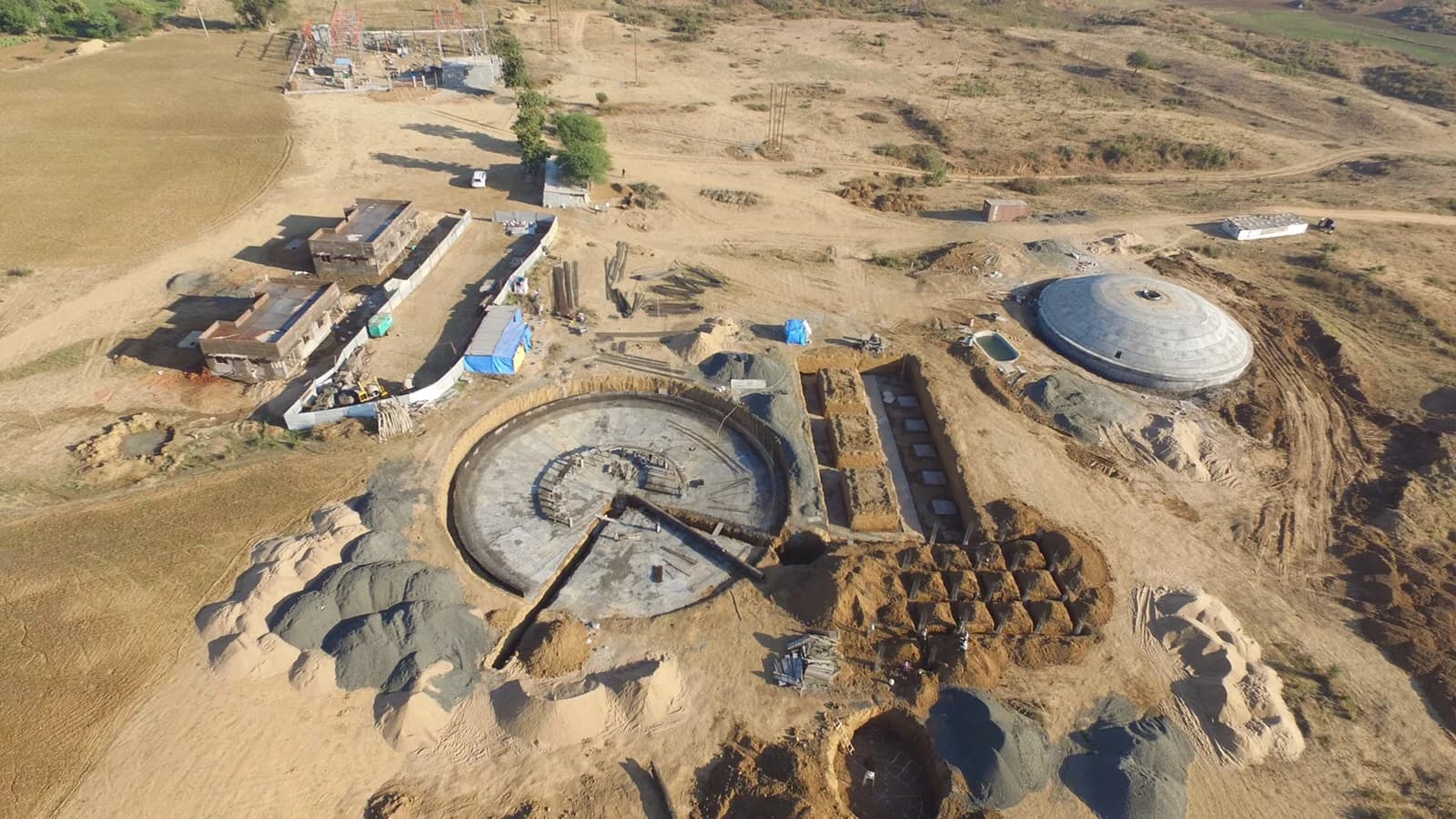
Jal Jeevan Mission — India's Largest Rural Water Supply Programme
Launched by the Government of India in August 2019, the Jal Jeevan Mission (JJM) — also known as Har Ghar Jal and Nal Se Jal — is perhaps the single largest rural infrastructure programme in India's history by beneficiary count. The mission's objective is straightforward but immense: provide safe piped drinking water, at the household level, to all 19 crore (190 million) rural households across India by the end of 2024.
The financial scale is equally historic: JJM's total outlay of ₹3.6 lakh crore (₹3.6 trillion) — funded jointly by the central government and state governments in a 60:40 ratio — makes it one of the largest public works programmes in the world. For civil contractors, JJM represents a generational opportunity in rural infrastructure.
The mission is administered through state-level implementation agencies: GWSSB (Gujarat Water Supply and Sewerage Board) in Gujarat, PHED (Public Health Engineering Department) in states like Madhya Pradesh, Rajasthan, and Maharashtra, and equivalent agencies in other states. These agencies issue tenders for multi-village group water supply schemes — each scheme covering 10–50 villages and requiring a complete civil package: intake structure, WTP, clear water reservoir, pumping station, transmission main, elevated service reservoirs, and village-level distribution network.
As of early 2026, JJM has achieved connections to over 14 crore households — but significant rural areas still remain uncovered, and ongoing capital replacement, augmentation, and quality improvement projects continue to generate civil work orders across the country. For a civil contractor with experience in rural water supply, the JJM pipeline remains full.
What Civil Works Does JJM Involve?
A typical multi-village group water supply scheme under JJM involves civil works across a chain of infrastructure components — from source to tap:
Intake Structure:
The water supply scheme begins at the water source — a river, reservoir, canal, or open well. The intake structure is a civil structure built in or near the water body to draw raw water. River intakes involve construction of a sump well (RCC circular chamber sunk into the riverbed or riverbank), with intake pipes fitted with screens to exclude debris, and a pump house on the bank. Reservoir intakes involve an RCC intake tower structure built within the reservoir, with draw-off pipes at multiple levels to avoid drawing surface or bottom water.
Water Treatment Plant (WTP):
Raw water from the intake is pumped (via raw water rising main) to the WTP for treatment to BIS 10500 drinking water standards. The WTP civil structures include: flash mixer chamber, clariflocculator (circular RCC tank, typically 6–25 m diameter), filter house (gallery of rapid sand filter cells — each cell a rectangular RCC structure 3–6 m wide, 1.5 m deep sand filter bed, with underdrains and backwash troughs), chlorination room, clear water reservoir (CWR — large underground or semi-underground RCC tank for treated water storage, typically 1–5 days' supply), and chemical handling and dosing area.
Transmission Main Pipeline:
From the WTP, treated water flows (by gravity or pumping) through the transmission main to the distribution zones. Transmission mains in JJM range from 100 mm to 600 mm diameter, in MS (mild steel), DI (ductile iron), or HDPE (high-density polyethylene) pipes. The civil scope includes pipeline trench excavation, bedding, laying, jointing, hydraulic testing, and reinstatement of road surfaces.
Pumping Stations:
Where gravity flow is insufficient (hilly terrain, long distances, high-elevation villages), intermediate pumping stations are required. Civil scope: pump house building, underground wet sump, dry well, cable trench, overhead crane provisions, boundary wall.
Elevated Service Reservoir (ESR):
The ESR — commonly known as an overhead water tank — is the distribution system's pressure head. JJM ESRs range from 50,000 litres to 5 lakh litres in capacity, on staging heights of 12–25 metres, depending on the terrain. The civil structure involves RCC circular tank on hollow cylindrical staging (or intze design on column staging). ESR construction requires precision shuttering for the circular tank and braced column/staging system — civil work that demands experienced contractors.
Village Distribution Network:
Within each village, the civil scope includes distribution pipeline (HDPE, 20–110 mm), household service connections, water meter chamber construction, sectional control valve chambers, and public standposts where individual connections are not yet laid.
How VRSIPL Executes JJM Projects
VRSIPL has been executing rural water supply civil projects for over three decades — long before JJM was launched. Our experience with GWSSB, PHED, and rural water supply agencies makes us one of the most capable JJM civil contractors operating in western and central India.
State Tendering:
VRSIPL participates in JJM tenders issued by GWSSB (Gujarat), PHED (Madhya Pradesh and Rajasthan), and equivalent agencies. Our class registrations — Class-AA with Gujarat PWD and equivalent in MP and Rajasthan — qualify us for the largest multi-village group water supply scheme tenders.
Multi-Village Scheme Execution:
A typical multi-village scheme covers a geographical area of 50–200 sq.km., with villages spread across varying terrain. VRSIPL's execution approach involves establishing a central batch plant near the WTP site, deploying independent pipeline laying gangs for each sub-zone, and coordinating simultaneously across multiple villages to compress the overall programme.
Remote Village Access:
JJM projects in tribal and hilly areas of Gujarat (Chhota Udaipur, Narmada, Dang districts) and MP (Jhabua, Alirajpur) involve remote village access on kachcha roads, narrow lanes, and hilly terrain. VRSIPL has invested in appropriate equipment — small concrete mixers, mini excavators, hand compactors — that can work in these constrained conditions.
Pipeline Scale:
VRSIPL has laid 3,000+ kilometres of water supply pipelines across rural Gujarat and Madhya Pradesh, covering HDPE pipelines (25 mm to 400 mm), MS pipelines (150 mm to 700 mm), and DI pipelines (100 mm to 500 mm). Our pipeline quality team conducts hydraulic testing on every section (250m to 500m segments) before backfilling, ensuring zero pressure failures at commissioning.
WTP Civil Experience:
VRSIPL has completed 45+ WTP civil projects ranging from 0.5 MLD to 40 MLD capacity, including clariflocculator civil, rapid sand filter gallery construction, clear water reservoir (below-grade RCC tank, IS:3370 compliant), and chemical house. Our WTP civil teams understand the precise level requirements for filter underdrain installation, the concrete quality requirements for watertight CWR construction, and the coordination interface with WTP equipment vendors.
Water Quality and Compliance in JJM Civil Works
JJM mandates that the water supplied to every household meets BIS 10500:2012 (Drinking Water Standard) quality parameters. This quality obligation flows directly through to civil construction requirements:
IS:3370 RCC Tanks:
All water-contact RCC structures — clear water reservoirs, ESRs, filter chambers — must be constructed to IS:3370 Part 1 and Part 2 (Code of Practice for Concrete Structures for the Storage of Liquids). IS:3370 specifies crack-width control (maximum 0.1–0.2 mm), minimum cement content (330 kg/m³), maximum water-cement ratio (0.45), and continuous pours for tank walls to avoid cold joints. VRSIPL's WTP civil teams are specifically trained in IS:3370 concrete requirements.
Watertightness Testing:
Every CWR and ESR must undergo a water-tightness test — filling to the design water level and monitoring water drop over 24–48 hours. Acceptance criterion is typically no more than 1/500th of the tank volume lost per day (or as specified in the contract). VRSIPL has a 100% first-time pass rate on tank watertightness tests across all JJM projects.
BIS Standard Pipes:
GWSSB and PHED specifications require pipes compliant with BIS standards: IS:4984 for HDPE pipes, IS:9523 for DI pipes, IS:3589 for MS pipes. VRSIPL sources pipes from BIS-certified manufacturers and maintains pipe material inspection records — mill certificates and third-party test reports — as part of quality documentation.
CPHEEO Manual Compliance:
The Central Public Health and Environmental Engineering Organisation (CPHEEO) Manual on Water Supply and Treatment is the primary design reference for WTP civil design in India. VRSIPL's civil design team works to CPHEEO manual standards for filter design, chlorination, and service reservoir sizing.
Water Testing Laboratories:
Many large JJM schemes include a district-level water testing laboratory building as part of the civil scope. VRSIPL has built several such laboratory civil structures — including vibration-free flooring for analytical instruments, chemical storage rooms, and ventilation provisions.
VRSIPL's JJM Projects in Gujarat and MP
VRSIPL's Jal Jeevan Mission project portfolio spans multiple states, with particular depth in Gujarat and Madhya Pradesh.
In Gujarat, VRSIPL has executed civil works for several GWSSB multi-village group water supply schemes in Vadodara, Narmada, Chhota Udaipur, Bharuch, and Panchmahal districts. Notable projects include civil execution for North Zone Vadodara Water Supply augmentation, Waghodia taluka multi-village water supply scheme, and the Netrang-Valia multi-village group scheme in South Gujarat covering 65+ villages.
In Madhya Pradesh, VRSIPL has executed rural water supply civil works under PHED tenders in Khandwa, Harda, Dewas, and Barwani districts — covering WTP civil construction, ESR construction (including 3 lakh litre to 5 lakh litre capacity ESRs on 15–20 m staging height), and bulk transmission pipeline laying in challenging tribal belt terrain.
Across these projects, VRSIPL has delivered water supply civil infrastructure to over 500 villages — bringing clean, piped drinking water to rural communities that previously depended on open wells, tanker supplies, and seasonal streams. This is not just infrastructure delivery — it is a measurable public health achievement, and VRSIPL is proud of the scale of impact our JJM civil works have enabled.
FAQ — Jal Jeevan Mission WTP Civil Works
Q1: What class registration does a contractor need to participate in JJM tenders from GWSSB or PHED?
For GWSSB (Gujarat) tenders, JJM civil contracts typically require Class-AA registration with the Gujarat PWD, with specific eligibility conditions on minimum similar work value executed. For PHED (Madhya Pradesh) tenders, Class-I CPWD or equivalent MP PWD registration is required for larger tenders. VRSIPL holds Class-AA (Gujarat) and Class-I credentials for MP, enabling participation in the largest JJM scheme tenders.
Q2: How does VRSIPL handle ESR (Elevated Service Reservoir) construction in remote rural sites?
ESR construction in remote locations involves transporting shuttering material, reinforcement steel, and concrete materials on kachcha village roads. VRSIPL uses mobile concrete batching plants that can be deployed close to the ESR site, reducing dependence on ready-mix supply. Our ESR construction teams are experienced in both circular RCC tank (intze/cylindrical design on hollow cylindrical staging) and rectangular ESR on column staging, with hydraulic jump-form shuttering for efficient staging construction.
Q3: Does VRSIPL handle pipeline laying in rocky terrain or river crossings?
Yes. VRSIPL's pipeline teams are equipped for hard rock excavation (hydraulic rock breakers, rock drills), and we have executed river crossings using HDD (Horizontal Directional Drilling) for large-diameter MS pipelines under rivers. For shallow streams, we execute conventional open-cut crossings with RCC-encased crossings or HDPE ductile crossings above streambed.
Q4: How long does a typical multi-village JJM scheme take from contract award to completion?
A scheme covering 30–60 villages with a 5–10 MLD WTP, 100–300 km of distribution pipeline, 6–10 ESRs, and source works typically takes 24–36 months from contract award. VRSIPL's programme management approach focuses on establishing early milestones (WTP civil complete, ESRs commissioned) to enable partial system commissioning by month 18–20, with full village coverage following progressively.
Q5: Does VRSIPL operate and maintain JJM water supply schemes after completion?
VRSIPL is primarily a civil EPC contractor — our core business is design-and-build civil execution, not long-term O&M. However, we provide the mandatory defect liability period (typically 12–24 months) maintenance during which any civil defects are rectified at VRSIPL's cost. For JJM schemes, the O&M responsibility after DLP typically passes to GWSSB/PHED or village-level organisations (water committees) under the JJM programme framework.
Related Topics
Continue Reading
Related Articles
Choosing an STP Civil Contractor in India — Municipal & Industrial Guide 2026
Pharma Plant Civil Construction in GIDC Gujarat — Site Development to Handover
ETP and ZLD Civil Works for Chemical Industries in GIDC — Complete Guide
Our Related Services
VRSIPL Services Covered in This Guide
Start Your Project
Have an Infrastructure Project?
Contact VRSIPL.
48 years of civil EPC delivery across India — WTP, STP, ETP, industrial civil, power plant, roads, and railways. Class-AA Gujarat. ISO 9001 | 14001 | 45001.