
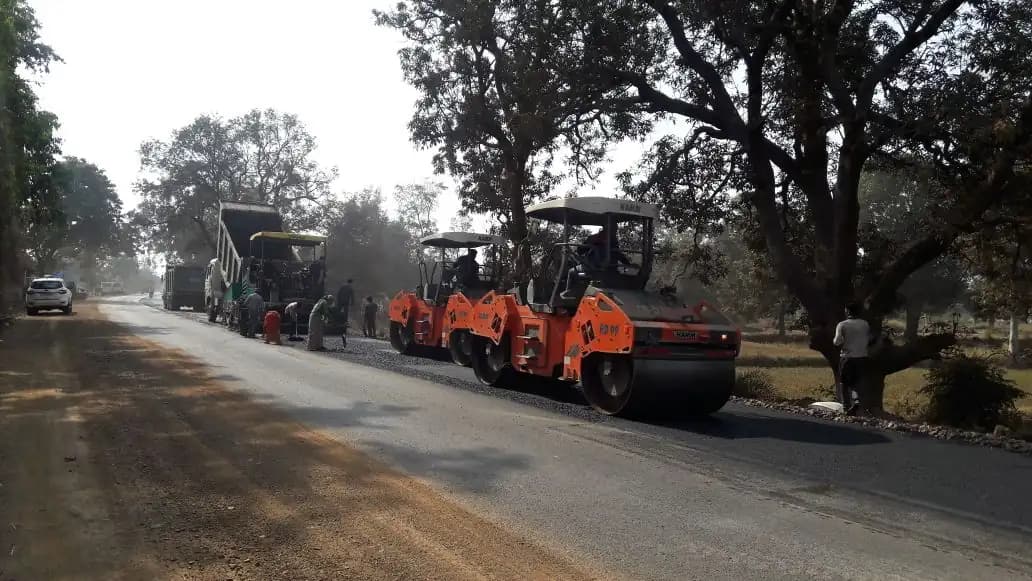
Types of Bridges and Flyovers in Indian Infrastructure
Indian infrastructure projects involve several types of elevated structures:
Urban Flyovers:
Grade separators at busy intersections and corridors. Typically 500m–5km long, 10–15m elevated. Common in smart city and AMRUT projects.
Highway ROBs (Road Over Bridges):
Crossing railway lines on highway projects. Typically 4–6 span structures (total 200–500m). Required wherever a highway crosses a railway.
River Bridges:
Crossing rivers on highway and railway alignments. Span lengths from 20m (minor streams) to 120m+ (major rivers). Foundation design governed by scour depth.
Elevated Corridors:
Long elevated highway sections through congested urban areas (like the Ahmedabad-Vadodara Expressway elevated section). Continuous for several km.
Pedestrian Bridges / FOBs:
Steel or RCC foot-over-bridges at railway stations and busy roads.
VRSIPL has constructed 200+ bridge and flyover structures across projects — from single-span culverts to 300-metre multi-span river bridges.
Foundation — Pile Boring and Pile Cap
90% of bridges in India use bored cast-in-situ pile foundations. The process:
1. Setting Out:
Establish pile location using total station to ±10mm accuracy.
2. Pile Boring:
Rotary hydraulic rig bores through soil/rock to design depth (typically 15–30m). In soft soil, boring proceeds with bentonite slurry stabilization. In rock, a rock chisel or DTH hammer bores the socket.
3. Reinforcement Cage:
Pre-fabricated steel cage (typically 12–20mm bars in circular arrangement) is lowered into the bore. Cover blocks ensure minimum 75mm clear cover.
4. Concreting:
Tremie method — concrete (M35–M45, high-workability mix with 150–200mm slump) is placed through a tremie pipe from the bottom up, displacing the bentonite slurry. Continuous pour — cannot be interrupted.
5. Pile Testing:
Initial piles are tested by maintained load test (to 2.5x working load) or high-strain dynamic testing. Working piles tested by PDA (Pile Driving Analyzer) or integrity testing (PIT).
6. Pile Cap:
After pile heads are trimmed to design level, a massive RCC pile cap (typically 2–4m square, 1.5–2m deep) is cast connecting 2–6 piles into a single structural unit that supports the pier.
VRSIPL operates piling rigs boring 1000mm–1500mm diameter piles to depths of 30+ metres in all soil types.
Pier and Pier Cap Construction
The pier is the vertical column that transfers deck loads to the foundation. Construction involves:
Pier Stem:
Typically circular (1.5–3m dia) or rectangular in cross-section, rising 5–15m from pile cap to pier cap. Cast using climbing formwork in 3–4m lifts. Concrete grade: M40–M50. Wall thickness for hollow piers: 400–600mm.
Climbing Formwork:
Steel form panels are bolted together around the pier, concrete is poured and vibrated, and after setting (24–48 hrs), the formwork is 'climbed' (jacked up) to the next lift position. Repeat until pier reaches design height.
Pier Cap (Hammer-head):
The T-shaped or rectangular cap at the top of the pier that supports the bearings and receives the superstructure load. Often heavily reinforced with complex geometry. Cast with special cantilevered formwork.
Quality Requirements:
- Verticality: ±1:600 (pier must be plumb to within 20mm over 12m height) - Surface finish: Fair-faced concrete with no honeycombing - Cover: Minimum 45mm (exposure condition: severe) - Strength: Minimum M40 for piers in modern designs
Superstructure — Girder Launching and Deck Casting
The superstructure (the deck you drive on) is the most engineered component. Common methods:
1. Precast PSC I-Girders (most common for spans 20–40m):
- Girders are cast at a nearby casting yard using long-line or short-line method - Prestressed with high-tensile strands (12.7mm, 7-wire, 1860 MPa) - Launched into position using a launching girder (overhead gantry) or crane - Deck slab cast in-situ over the placed girders
2. Precast Segmental Construction (for spans 30–60m):
- Short box segments (3–4m long) are cast in a match-cast sequence - Transported to site and erected by launching gantry or crane - Post-tensioned together with high-tensile cables threaded through internal ducts - Grouted to prevent corrosion of tendons
3. Cast-in-Situ Balanced Cantilever (for spans 60–120m):
- Pier-mounted form travellers cast 3–5m segments alternately on each side of the pier - Each segment is post-tensioned before the next is cast - When two cantilevers meet at mid-span, a closing segment connects them
4. Steel-Concrete Composite:
- Steel girders (plate girders or box girders) are erected by crane - RCC deck slab is cast over the steel girders with shear connectors - Used for rapid construction or very long spans
VRSIPL has launched 500+ precast PSC girders using both overhead launching girders and mobile cranes, with individual girder weights up to 80 tonnes.
Finishing Works — Bearings, Expansion Joints, Crash Barriers
After the structural deck is complete, finishing works transform it into a usable road:
Bearings:
Elastomeric (neoprene pad) or pot-PTFE bearings are installed between pier cap and girder. They allow thermal expansion/contraction and rotation while transferring vertical loads.
Expansion Joints:
Strip seal or modular expansion joints at deck ends accommodate ±50mm to ±300mm movement. Proper installation prevents water leakage onto bearings and piers.
Crash Barriers:
New Jersey (NJ) type RCC crash barriers on both edges. Height: 900mm for standard bridges, 1100mm for high-speed corridors.
Wearing Course:
50–75mm bituminous concrete or mastic asphalt over the RCC deck with a waterproofing membrane beneath.
Drainage:
Weep holes and drain spouts at 5–10m spacing to prevent water accumulation on deck.
Approach Slabs:
3.5–5m RCC slabs at both ends to prevent the 'bump' caused by differential settlement between bridge and approach embankment.
Utilities:
Utility ducts for cables, water supply pipes, and lighting conduits are cast into the deck during construction.
Related Topics
Continue Reading
Related Articles
Pharma Plant Civil Construction in GIDC Gujarat — Site Development to Handover
Choosing an STP Civil Contractor in India — Municipal & Industrial Guide 2026
ETP and ZLD Civil Works for Chemical Industries in GIDC — Complete Guide
Our Related Services
VRSIPL Services Covered in This Guide
Start Your Project
Have an Infrastructure Project?
Contact VRSIPL.
48 years of civil EPC delivery across India — WTP, STP, ETP, industrial civil, power plant, roads, and railways. Class-AA Gujarat. ISO 9001 | 14001 | 45001.