
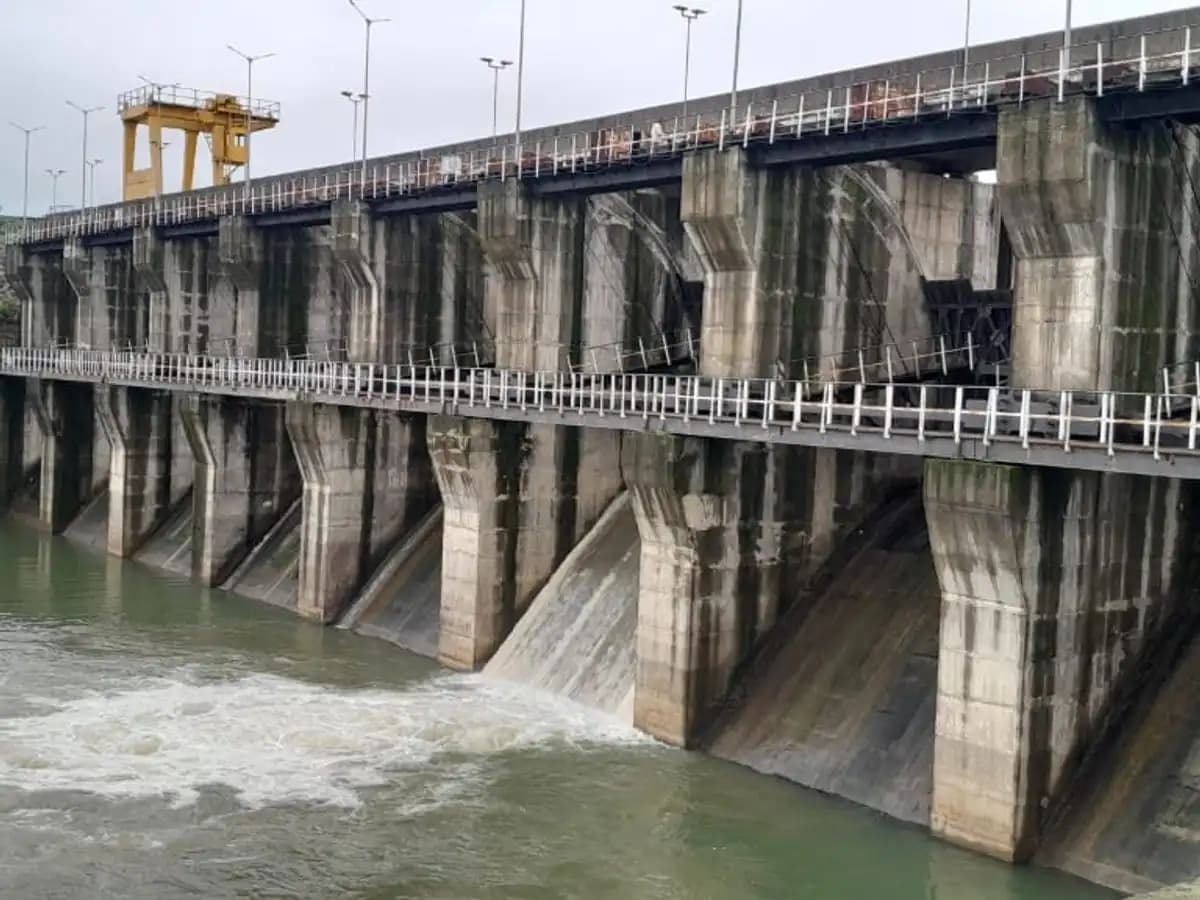
Types of Dams Built in India
India builds three primary types of dams depending on geology, hydrology, and available construction materials:
Earthen Embankment Dams (70% of India's dams):
Built from compacted earth (clay core with random fill shells). Suitable for wide valleys with alluvial foundations. Heights typically 15–60 metres. Examples: Tawa Dam (MP), Ukai Dam (Gujarat), Hirakud Dam (Odisha).
Concrete Gravity Dams (20% of India's dams):
Massive concrete structures that resist water pressure by their own weight. Suitable for narrow valleys with hard rock foundations. Heights up to 260 metres. Examples: Bhakra Dam (HP), Sardar Sarovar Dam (Gujarat), Nagarjuna Sagar Dam (AP/Telangana).
Masonry Dams:
Older construction method using stone masonry with cement mortar — many dams built pre-1960 are masonry gravity dams. Still used for small check dams and barrages.
Composite Dams:
Combination of concrete and earthen sections — concrete in the river gorge for the spillway, and earthen flanks on either side where the valley widens. This is very common in Indian practice.
VRSIPL has constructed earthen dams, barrages, and canal head-works across Gujarat and Madhya Pradesh, with the Bilgaon Dam being a notable recent project.
River Diversion — The First Challenge
Before dam construction can begin, the river must be diverted away from the construction zone. This is arguably the most challenging and risky phase:
Cofferdam Method:
Temporary earthen or rockfill bunds (cofferdams) are built upstream and downstream of the dam site, diverting the river through: - Diversion tunnels (bored through the abutment rock) - Diversion channels (cut around one side of the valley) - Existing river bed slots (for stage construction)
Stage Construction:
For very wide rivers, the dam is built in stages — first one half of the river bed is closed with a cofferdam while the river flows through the other half, then vice versa.
Monsoon Protection:
All diversion works must be designed to safely pass the monsoon flood. Underestimating the diversion flood is the most common cause of cofferdam overtopping and work damage. Typically, the diversion system is designed for a 25-year return period flood during construction.
VRSIPL's approach:
On the Bilgaon Dam project, VRSIPL constructed upstream and downstream cofferdams with controlled overtopping design, allowing monsoon floods to pass safely while protecting the dam foundation zone.
Foundation Treatment for Dams
A dam is only as strong as its foundation. Foundation treatment ensures the dam base is watertight and can safely carry the structure's load:
For Earthen Dams on Alluvial Foundations:
- Core trench: Excavate a trench into impervious stratum and backfill with compacted clay - Sheet pile cut-off: Drive steel sheet piles through permeable overburden - Cement-bentonite slurry wall: For deep alluvial deposits (30m+) - Relief wells: Downstream pressure relief to prevent piping failure
For Concrete Dams on Rock Foundations:
- Stripping: Remove all weathered rock to expose fresh, competent rock surface - Dental treatment: Fill all cracks, joints, and cavities with concrete - Consolidation grouting: Inject cement grout at low pressure (3–5 kg/cm²) to fill near-surface rock joints - Curtain grouting: Deep grout curtain (depth = 30–50% of water head) to prevent under-seepage. Drilled at 3m spacing, injected at pressures up to dam height in metres × 0.5 kg/cm² - Drainage gallery: Internal gallery with drain holes drilled downstream of the grout curtain to relieve uplift pressure
Foundation treatment can represent 10–20% of total dam cost but is absolutely non-negotiable for safety.
Embankment Dam Construction
Earthen dam construction is an exercise in controlled compaction of millions of cubic metres of earth:
Zoning:
A typical zoned earthen dam has: - Impervious core (compacted clay, 15–20% of dam width) - Transition filters (graded sand/gravel) on both sides of the core - Random fill shells (compacted available soil/rock) - Upstream stone pitching or riprap for wave protection - Downstream toe drain for safe seepage collection
Construction Sequence:
1. Foundation preparation (stripping, core trench) 2. Build dam in horizontal layers (150–230mm loose thickness per lift) 3. Each lift: spread by bulldozer → moisture conditioning by sprinkler → compaction by sheepsfoot roller (core) or vibratory roller (shells) 4. Quality check: field density test every 500 cum (95–98% Standard Proctor Density required for core) 5. Continue lifting through dry season, protect partial dam from monsoon overtopping
Placement Rates:
A well-equipped contractor achieves 3,000–10,000 cum/day depending on borrow area distance, dam width at current level, and season.
VRSIPL deployed fleets of 20+ tippers, sheepsfoot rollers, and vibratory compactors on dam projects, achieving sustained placement rates of 5,000+ cum/day.
Spillway Construction
The spillway is the dam's safety valve — it safely passes flood flows over or around the dam without overtopping the embankment. Spillway types include:
Ogee Spillway:
The classic curved-crest concrete spillway designed for efficient high-velocity flow. Used on concrete gravity dams.
Chute Spillway:
A concrete-lined channel on the dam abutment, often with stilling basin energy dissipator at the downstream end.
Side Channel Spillway:
Flow enters a channel parallel to the dam crest, then turns 90° into a chute. Used where the dam crest is at a higher elevation than the spillway crest.
Shaft (Morning Glory) Spillway:
Circular overflow crest with vertical shaft and tunnel — used where space for a conventional spillway is unavailable.
Spillway civil construction involves:
- Massive concrete volume (often 50,000–200,000 cum for major dams) - Precise curved formwork for ogee crest - Reinforcement for cavitation-prone zones - Stilling basin with baffle blocks and end sill - Training walls and guide walls - Gates and hoisting arrangement foundations
Spillway concrete must be high-quality (M20–M30) with controlled temperature to prevent thermal cracking in massive pours.
FAQ — Dam Construction in India
Q1: What is dam construction?
Dam construction is the process of building a barrier across a river or stream to store water in a reservoir for irrigation, drinking water supply, hydropower, or flood control. It involves three major phases: diverting the river away from the work area (using cofferdams or diversion tunnels), treating the foundation to make it watertight and stable, and building the dam body itself — either as compacted earth (earthen embankment dam) or mass concrete (gravity dam) — along with a spillway to safely pass flood flows.
Q2: How long does it take to build a dam in India?
Timelines vary hugely with dam height, river width, and foundation conditions. A medium-height earthen dam (30–40m) on a moderate-width river typically takes 3–5 years, including 2–3 dry-season construction windows between monsoons (since embankment work must pause when the river floods the cofferdam area). Larger dams with deep foundation treatment or wide rivers requiring staged river diversion can take considerably longer.
Q3: What is the difference between an earthen dam and a concrete gravity dam?
An earthen embankment dam is built from compacted earth in zoned layers (impervious clay core, filter zones, and rock/soil shells) and is suited to wide valleys with alluvial (soil) foundations — about 70% of India's dams are this type. A concrete gravity dam is a solid mass-concrete structure that resists water pressure purely through its own weight, requiring a hard rock foundation, and is used in narrower valleys where a taller, more compact structure is justified. Earthen dams are generally more economical for wide sites; concrete gravity dams are preferred where rock foundations allow greater height in less width.
Q4: What determines dam construction cost?
Dam cost depends primarily on dam type (earthen vs concrete), height, foundation treatment required (grouting and cut-off work alone can be 10–20% of total cost), river diversion complexity, and spillway size. Because these variables differ so much project to project, dam costs are normally estimated per project after a detailed geotechnical and hydrological survey rather than quoted as a flat per-unit rate.
Q5: Does VRSIPL build dams and barrages in India?
Yes. VRSIPL has constructed earthen dams, barrages, and canal head-works across Gujarat and Madhya Pradesh, including the Bilgaon Dam, with experience spanning river diversion, foundation treatment, embankment construction, and spillway works as described in this guide.
Related Topics
Continue Reading
Related Articles
Irrigation Canal Lining in India — CC Lining, HDPE Lining & Construction Process
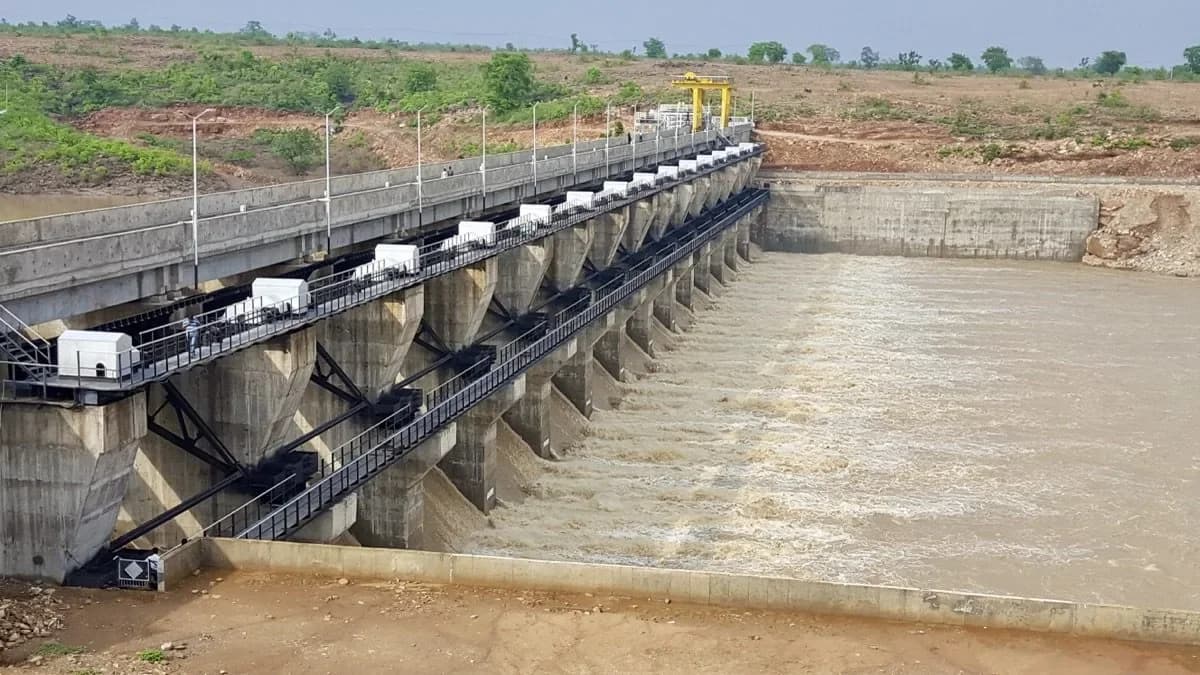
Barrage & Weir Construction in India — Diversion Structures for Irrigation
Concrete Dam vs Earthen Dam — Which Type is Better for Indian Conditions?
Our Related Services
VRSIPL Services Covered in This Guide
Start Your Project
Have an Infrastructure Project?
Contact VRSIPL.
48 years of civil EPC delivery across India — WTP, STP, ETP, industrial civil, power plant, roads, and railways. Class-AA Gujarat. ISO 9001 | 14001 | 45001.