
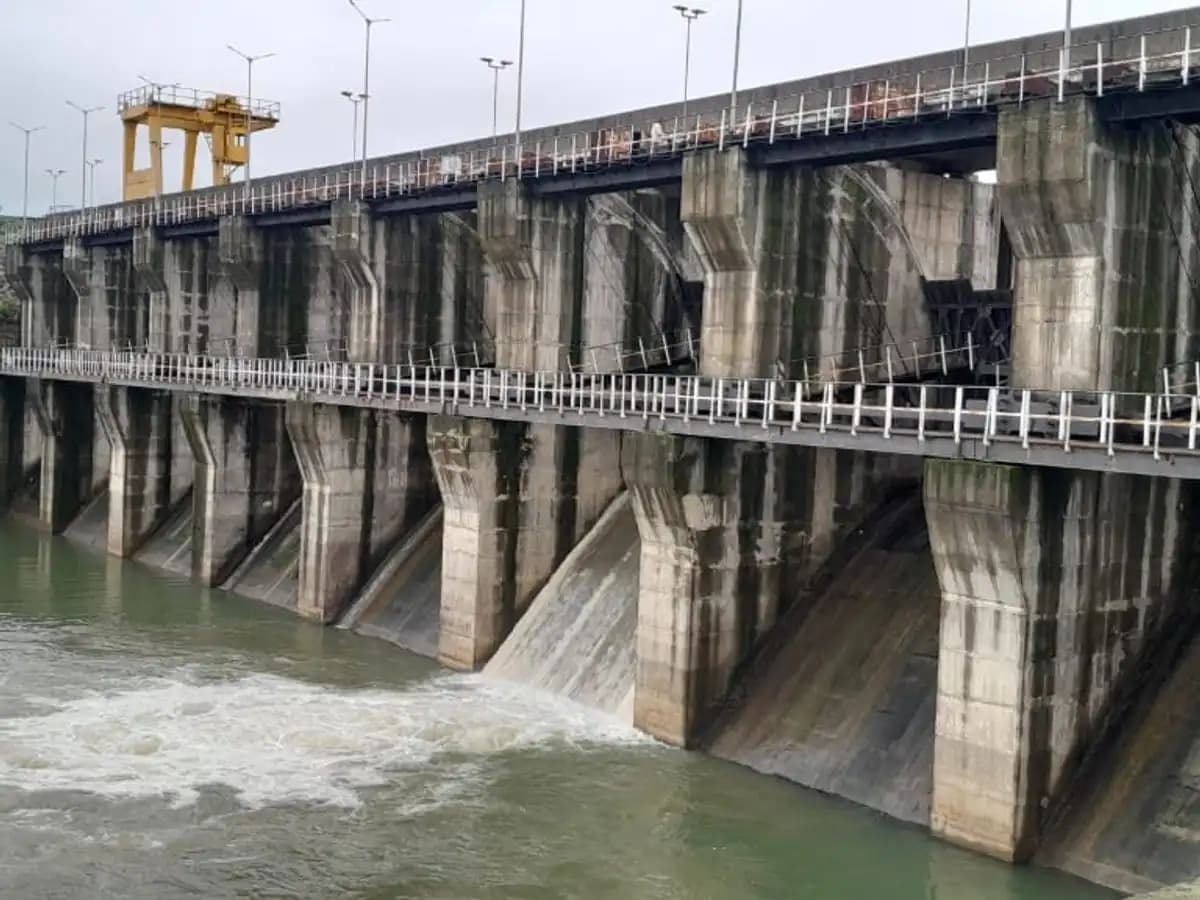
Head-to-Head Comparison
| Parameter | Earthen Dam | Concrete Gravity Dam | |-----------|-------------|---------------------| | Foundation | Can be built on alluvial/soft foundations | Requires hard rock foundation | | Valley Shape | Suited for wide valleys | Suited for narrow gorges | | Height | Practical limit ~150m | Can exceed 300m | | Material | Local earth/rock fill | Cement, aggregate, sand | | Spillway | Separate chute spillway (cannot overtop dam) | Can be integral (overflow section) | | Construction | Seasonal (monsoon interrupts) | Less weather-sensitive | | Seepage | Requires careful core/filter design | Concrete is inherently watertight | | Cost | Lower for wide valleys | Lower for narrow valleys | | Time | Faster for most Indian sites | Requires longer (high concrete volume) | | Failure Mode | Piping, overtopping (sudden, catastrophic) | Sliding, overturning (more predictable) | | Instrumentation | Essential (pore pressure, settlement) | Important but less critical | | Rehabilitation | Difficult (cannot raise easily) | Easier (add concrete, raise crest) |
When to Choose Earthen Dam
Geological Conditions:
- Alluvial foundation (clay, sand, gravel) — cannot support a concrete dam - Wide valley (>200m) where concrete volume would be prohibitive - Availability of suitable impervious soil (clay) within economic haul distance
Economic Factors:
- Lower cost per unit storage for wide valleys - Uses locally available materials (earth, rock) with minimal cement - Lower construction equipment requirement
Indian Examples:
- Tawa Dam (MP): 58m high, 1,815m long — earth and rock fill on alluvial foundation - Ukai Dam (Gujarat): 69m high, 4,927m long — one of India's longest earth dams - Tehri Dam (Uttarakhand): 260m high — India's tallest earth/rockfill dam
VRSIPL's Earth Dam Experience:
Bilgaon Dam, irrigation embankments, canal escape structures, and flood protection bunds across Gujarat and MP — with combined earthwork volume exceeding 50 lakh cubic metres.
When to Choose Concrete Dam
Geological Conditions:
- Sound rock foundation at or near surface - Narrow valley/gorge (concrete volume is manageable) - High-quality aggregate available nearby
Functional Requirements:
- Very high dam (>100m) where earthen dam footprint becomes impractical - Integral spillway needed (no space for separate spillway channel) - Underground powerhouse requires a concrete dam body for penstocks
Safety Considerations:
- Concrete dams can safely pass overtopping flows (earthen dams cannot — overtopping causes catastrophic breach) - More predictable failure mechanism allows better emergency planning - Less susceptible to internal erosion (piping)
Indian Examples:
- Bhakra Dam (HP): 226m concrete gravity dam — India's highest concrete dam - Sardar Sarovar Dam (Gujarat): 163m concrete gravity dam with 30 radial gates - Koyna Dam (Maharashtra): 103m concrete gravity dam
Modern Trend — RCC (Roller Compacted Concrete) Dams:
A hybrid — concrete placed and compacted like earthwork using vibratory rollers. Much faster than conventional concrete dams. Gaining popularity in India for moderate-height dams (30–80m).
Related Topics
Continue Reading
Related Articles
Irrigation Canal Lining in India — CC Lining, HDPE Lining & Construction Process
Dam Construction in India — Earthen, Concrete & Gravity Dams Explained
Barrage & Weir Construction in India — Diversion Structures for Irrigation
Our Related Services
VRSIPL Services Covered in This Guide
Start Your Project
Have an Infrastructure Project?
Contact VRSIPL.
48 years of civil EPC delivery across India — WTP, STP, ETP, industrial civil, power plant, roads, and railways. Class-AA Gujarat. ISO 9001 | 14001 | 45001.