
Barrages vs Weirs — Understanding the Difference
Both barrages and weirs raise the river water level to divert water into canals, but they differ in design:
Weir:
A low dam across the river with a fixed crest. Water flows over the crest. No gates (or limited gates for flood regulation). Simpler and cheaper. Used for smaller rivers and lower diversion requirements.
Barrage:
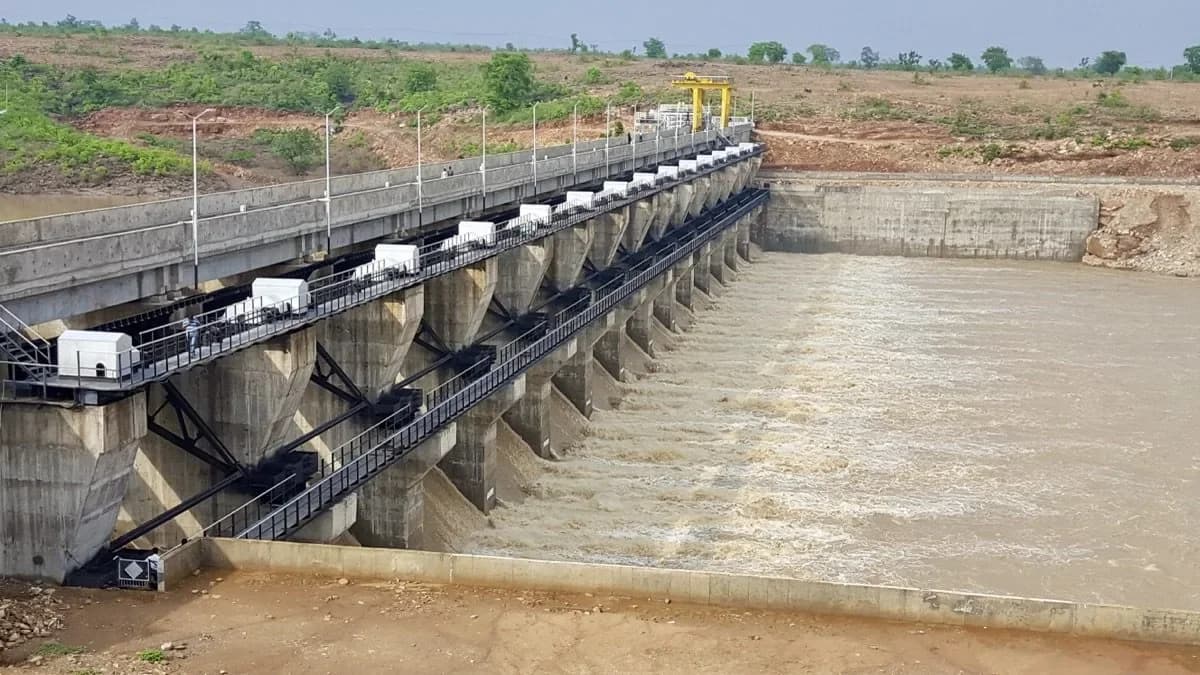
A gated structure across the river. The crest is at or near river-bed level. Water level is raised by closing gates (vertical lift gates, radial gates). Full control over upstream water level. Used for major rivers with large diversion canals.
Components of a Barrage:
- Concrete body wall (spanning the river, housing gate piers and sill) - Under-sluices (low-level gates near the canal head regulator for sediment flushing) - Divide wall (separating under-sluice bay from main barrage bays) - Fish ladder (for fish migration — now mandatory on all new barrages) - Canal head regulator (the off-take structure feeding the main canal) - Upstream and downstream cutoff walls (sheet piles or RCC for seepage control) - Upstream floor, downstream floor with energy dissipation (stilling basin) - Training works (guide bunds, marginal bunds to confine river flow)
VRSIPL constructed the Pancham Nagar Barrage on the Narmada canal system — a multi-bay gated barrage with canal off-takes serving thousands of hectares of irrigated command area.
Barrage Construction Process
Barrage construction follows a staged approach dictated by river hydrology:
Phase 1 — Dry Season Work (October–May):
- Construct cofferdam (sand-filled bund or sheet pile enclosure) around work area - Divert river flow through remaining open bays - Excavate foundation to design level (often 5–10m below river bed) - Construct cutoff walls (RCC or sheet pile) upstream and downstream - Cast concrete floor (upstream glacis, crest, downstream glacis, stilling basin) - Build gate piers up to operating platform level - Complete the section before monsoon arrives
Phase 2 — Monsoon Closure:
- Remove cofferdam before monsoon floods arrive - River flows through all open (unconstructed) bays - Protect completed work from flood damage
Phase 3 — Next Dry Season:
- Shift cofferdam to the next set of bays - Complete remaining barrage sections - This staged construction may take 3–5 monsoon seasons for a wide river
Phase 4 — Gate Installation and Canal Works:
- Install gate guides, sill beams, and hoist bridges - Install radial gates or vertical lift gates - Test gate operation - Construct canal head regulator and connect to main canal
Concrete Volume:
A typical 10-bay barrage requires 30,000–80,000 cum of concrete — equivalent to a medium-sized dam. Placement rates of 200–500 cum/day are typical with batching plants at both river banks.
Related Topics
Continue Reading
Related Articles
Irrigation Canal Lining in India — CC Lining, HDPE Lining & Construction Process
Dam Construction in India — Earthen, Concrete & Gravity Dams Explained
Concrete Dam vs Earthen Dam — Which Type is Better for Indian Conditions?
Our Related Services
VRSIPL Services Covered in This Guide
Start Your Project
Have an Infrastructure Project?
Contact VRSIPL.
48 years of civil EPC delivery across India — WTP, STP, ETP, industrial civil, power plant, roads, and railways. Class-AA Gujarat. ISO 9001 | 14001 | 45001.