
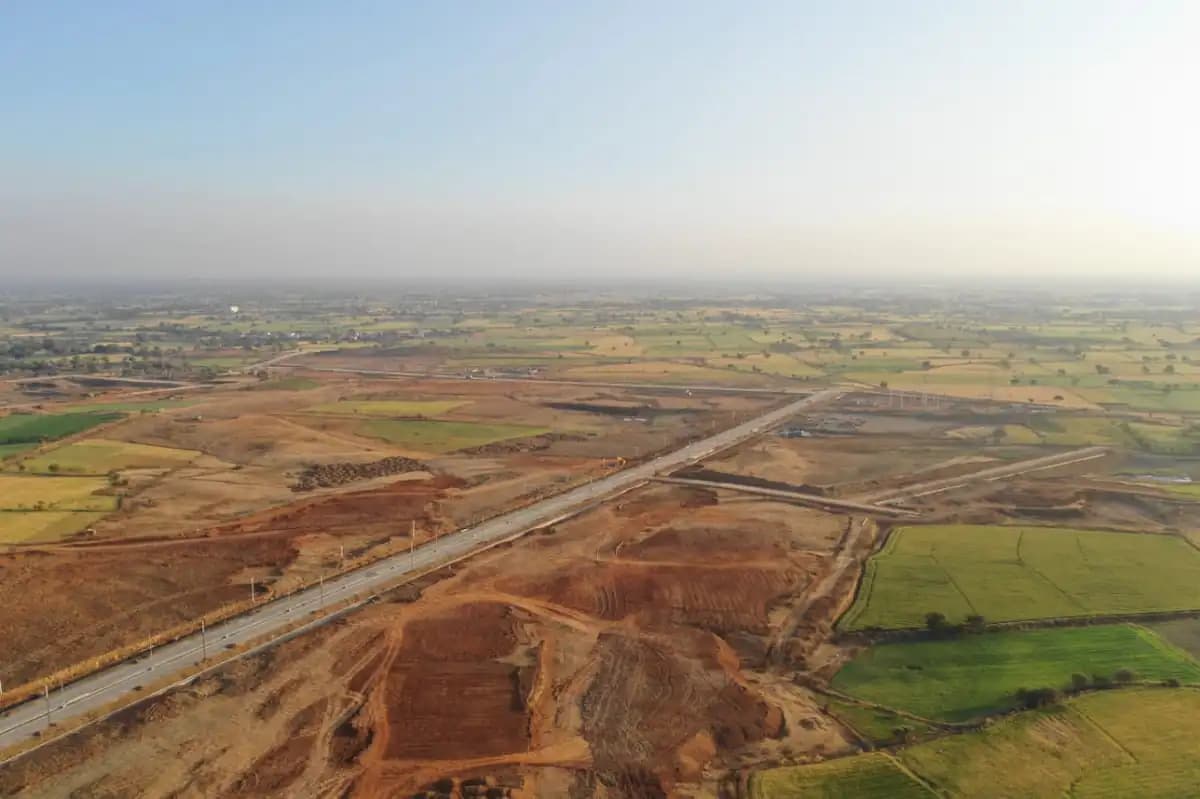
Industrial Shed Demand in India
India's industrial construction sector is booming driven by:
- Make in India and PLI schemes attracting manufacturing investment - E-commerce driving demand for large-format warehouses (1–5 lakh sq.ft) - GIDC/MIDC/RIICO industrial estates expanding with new allotments - China+1 strategy bringing FDI into Indian manufacturing - Data centres and logistics parks as new asset classes
Industrial sheds range from 2,000 sq.ft workshop sheds for MSMEs to 10 lakh sq.ft distribution centres for e-commerce giants. The two dominant construction methods are PEB (Pre-Engineered Building) for speed and RCC frame for permanence.
VRSIPL constructs both PEB foundations (the critical civil scope that PEB suppliers don't do) and complete RCC-framed industrial buildings across Gujarat's GIDC estates.
PEB vs RCC — Technical Comparison
PEB (Pre-Engineered Steel Building):
- Structure: Steel columns, rafters, purlins — manufactured in factory, assembled on site - Cladding: Colour-coated steel sheets (0.5mm) for roof and walls - Span: Up to 90m clear span (no internal columns) - Speed: 60–90 days from foundation to handover - Cost: ₹1,200–1,800/sq.ft (all-inclusive with foundation) - Life: 30–40 years (depends on maintenance/recoating) - Best for: Warehouses, automobile plants, food processing, any large-span requirement
RCC Framed Building:
- Structure: RCC columns, beams, slabs — cast in-situ - Cladding: Masonry walls with plaster, RCC slab roof (or AC sheets on steel trusses) - Span: Economical up to 12m (beyond needs heavy beams or trusses) - Speed: 6–12 months - Cost: ₹1,800–3,000/sq.ft - Life: 60–100 years - Best for: Multi-storey factories, pharma plants, heavy-equipment foundations, permanent structures
Hybrid Approach (Most Common):
RCC structure for process areas (where heavy loads, precision floors, or multi-storey is needed) + PEB for warehousing and utility areas. This optimises cost while meeting functional requirements.
VRSIPL delivers both — RCC-framed factory buildings for process industries and PEB foundation packages for steel building contractors.
PEB Foundation Construction — The Civil Contractor's Role
PEB suppliers (Zamil, Kirby, Tiger Steel, etc.) design and supply the steel structure. But the foundation is the owner's responsibility — and this is where the civil contractor is critical.
PEB Foundation Types:
1. **Isolated Column Foundations:** Separate RCC pad footings (1.5m x 1.5m to 3m x 3m, 1–2m deep) at each column location. The most common type for single-storey PEB sheds.
2. **Combined Footings:** When column spacing is tight or soil bearing capacity is low, adjacent columns share a combined footing.
3. **Pile Foundations:** In poor soil (marine clay, filled-up ground), bored piles (300–600mm dia, 6–15m deep) with pile caps support the PEB columns.
Anchor Bolt Setting — The Critical Interface:
PEB columns connect to the foundation through anchor bolts (typically 4–12 bolts per column, M24–M36 grade 8.8). These must be set with ±3mm tolerance in all three dimensions. Any error means the PEB column won't fit — and rework is extremely expensive.
VRSIPL's approach:
- Use precision anchor bolt templates (laser-cut steel plates) supplied by the PEB vendor - Survey each bolt group after concrete pour using total station - Correct any deviation before concrete hardens - Achieve zero-rejection rate on bolt group accuracy
Other civil scope for PEB projects:
- Site grading and compaction - Floor construction (M25 VDF concrete floor, 150–200mm thick, with joint-free panels up to 20m x 20m) - Plinth beams and plinth walls (600mm above FGL) - Utility trenches and pits - External works (roads, drains, boundary wall)
Industrial Flooring — The Most Abused Surface
Industrial floors take more punishment than any other element — forklift traffic, heavy storage loads, chemical spills, and thermal cycling. Types:
VDF (Vacuum Dewatered Flooring):
M25–M30 concrete poured, vacuum-dewatered (removing excess water), power-trowelled to a smooth, dense finish. Surface hardness: minimum 40 MPa. The standard for warehouses and logistics centres.
Tremix Flooring:
Similar to VDF but uses ride-on power trowels (Tremix machines) for finishing. Produces excellent flatness (FM2 class per TR34) over large areas.
Epoxy-Coated Floors:
For pharma, food processing, and electronics — VDF base with 2–3mm epoxy or polyurethane coating. Chemical-resistant, seamless, and easy to clean.
Heavy-Duty Floors:
For foundries, steel plants, and heavy engineering — 250–300mm M30 concrete with steel fibre reinforcement (25–40 kg/m³). Designed for point loads of 20+ tonnes.
Key specifications:
- Flatness: FM2 (F25/F20 per TR34) for racking aisles, FM3 for general warehousing - Joint layout: 6m x 6m panels (VDF) or 20m x 20m joint-free panels (laser screed) - Saw-cut joints within 8 hours of casting to control random cracking - Floor hardener (dry shake or liquid lithium silicate) for abrasion resistance
VRSIPL has constructed 5+ million sq.ft of industrial flooring — from basic factory floors to FM2-class VRN (Very Narrow Aisle) warehouse floors.
Related Topics
Continue Reading
Related Articles
Pharma Plant Civil Construction in GIDC Gujarat — Site Development to Handover
ETP and ZLD Civil Works for Chemical Industries in GIDC — Complete Guide
MIDC Industrial Civil Contractor — Factory & Plant Civil Works in Maharashtra
Our Related Services
VRSIPL Services Covered in This Guide
Start Your Project
Have an Infrastructure Project?
Contact VRSIPL.
48 years of civil EPC delivery across India — WTP, STP, ETP, industrial civil, power plant, roads, and railways. Class-AA Gujarat. ISO 9001 | 14001 | 45001.